
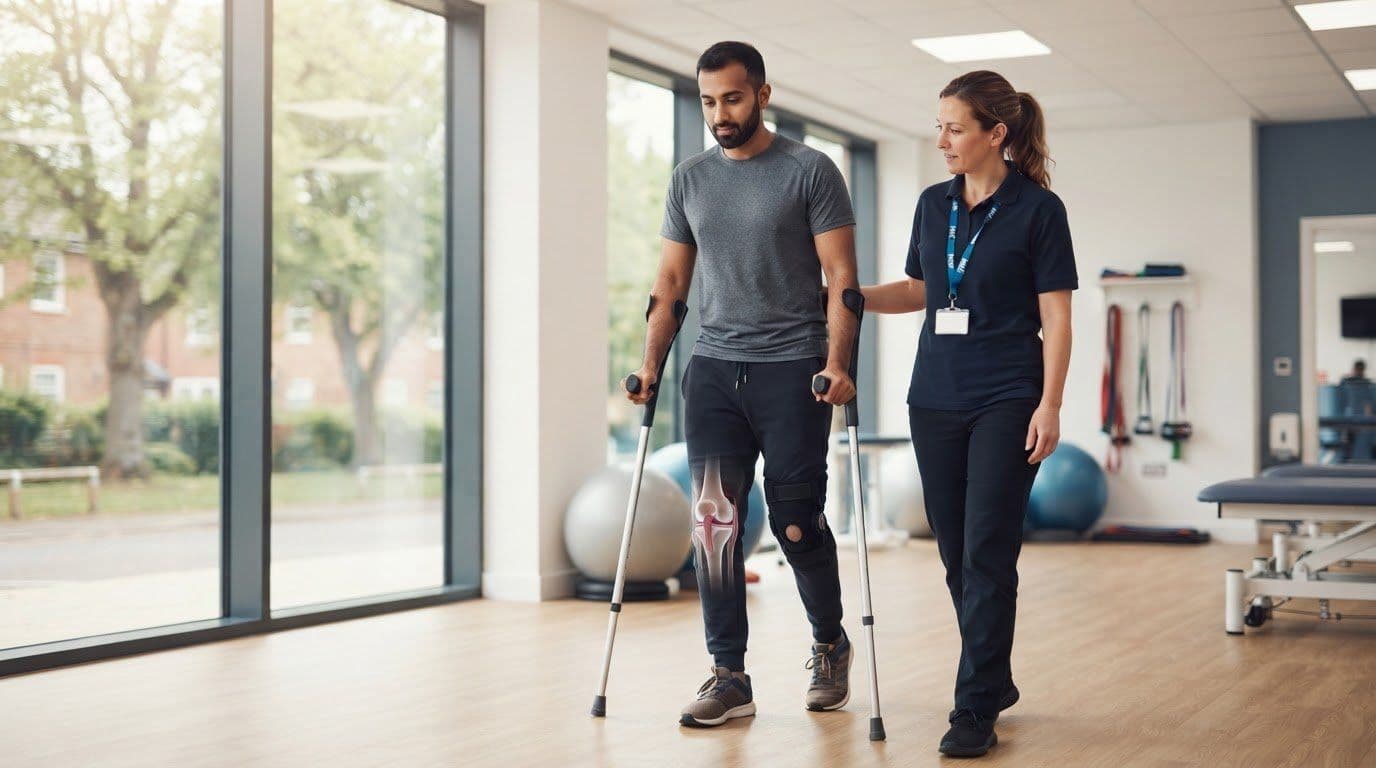
ACL reconstruction rehab in Towcester: walking and recovery time
Need support after ACL surgery? An ACL reconstruction rehab specialist in Towcester can explain crutches, swelling and when to build up walking and sport again.
Yes, you can usually walk with crutches on the day of ACL reconstruction surgery. Walking without them takes longer and depends on swelling, pain, knee extension and your surgeon’s instructions. An ACL reconstruction rehab specialist in Towcester can guide you through recovery milestones.
It’s understandable to wonder when you’ll walk normally again, especially when every step feels like a test. Recovery doesn’t follow one fixed timetable: getting around the house is different from returning to work, running or sport.
This guide explains what to expect when walking after surgery, how rehabilitation progresses and why managing swelling and straightening your knee matter. It also covers how everyday activity differs from the longer journey back to sport.
Key Takeaways
- Use your surgeon’s instructions and your knee’s response to guide how you progress from crutches towards walking unaided.
- Recovery moves through stages, with strength and movement goals shaping when you can take on more demanding activity.
- Returning to sport depends on rebuilding strength, balance and confidence, not simply reaching a date on the calendar.
- Pay attention to swelling, pain and your ability to straighten your knee, as these can influence your rehabilitation progress.
WHAT’S THE REHABILITATION PERIOD?
ACL rehabilitation progresses through milestones, from restoring everyday movement to preparing for sport. Your progress depends on strength, control and the demands of the activity you want to return to.
Rehabilitation milestones and return to sport
Rehabilitation milestones are checks that help show whether your knee is ready for more demanding tasks. They matter because returning to sport involves more than reaching a particular point in your recovery. A return to noncontact sport may be considered between 6 and 9 months after surgery. Contact sport generally takes longer, around 9 months to a year. Before contact sport, the operated knee should be within 10% of the other knee’s strength. Balance, hopping, agility and confidence also count.
Strength and return to run targets
Strength and return to run targets combine progressive exercises with checks on movement and control. A running programme and noncontact sport drills may begin between 3 and 6 months after reconstruction. Phase 2 builds balance and strength towards a squat or sit using one leg. Phase 3 adds safe hopping, agility and jump training. Muscle strength should have returned to normal at around six months, but your control during these tasks matters too.
Work has different demands. Physical work is usually possible 6 to 8 weeks after reconstruction. A desk based job may be manageable after 2 weeks if you can work using crutches. Standing, lifting and travelling can affect what returning to work involves.
Does private health insurance or the NHS cover ACL rehabilitation near Towcester? NHS rehabilitation is generally arranged through your surgical care pathway. Private insurance may cover physiotherapy, depending on your policy benefits and authorisation requirements.
A focused plan can help you build strength for daily movement and sport. Explore preventative care physiotherapy for support with maintaining movement and function.
How long does it take to recover from ACL surgery?
ACL reconstruction rehabilitation can continue for up to 12 months, depending on the function you’re rebuilding. Early recovery focuses on movement and swelling, while later work develops strength and prepares your knee for demanding activity.
During the first two weeks, rehabilitation focuses on swelling, knee movement and activating the muscles around your knee. From weeks two to six, physiotherapy progresses movement and strengthening. A further strengthening phase follows from weeks six to twelve, then functional training can build towards activity between three and six months.
Previous ACL surgery or physiotherapy matters because your starting strength, movement and experience help shape your plan. Tell your physiotherapist if your knee still feels unstable or swelling limits movement. Before surgery, physiotherapy can work on knee movement and leg muscles to help you prepare for recovery.
Which physiotherapists or sports rehabilitation specialists in Towcester treat people after ACL reconstruction? Look for a physiotherapist experienced in rehabilitation after knee surgery, who can adapt exercises to your operation and goals. Local clinics may provide different follow up, so ask how your rehabilitation will progress.
What ACL rehabilitation services are available in Towcester and nearby towns? Options include NHS outpatient physiotherapy and private physiotherapy. Which local clinics specialise in ACL and knee rehabilitation? Look for clinics describing care after knee surgery, rather than general treatment alone.
At your first appointment, expect to discuss your operation, symptoms and goals, followed by checks of knee movement, swelling and muscle strength. Bring your surgical instructions and details of any previous treatment.
For NHS rehabilitation, contact the team that arranged your operation to ask about outpatient follow up. If you have no follow up plan, speak to your GP practice about the appropriate referral route. For related information, see this guide to knee pain and rehabilitation.

Post surgery swelling, pain and knee extension
After anterior cruciate ligament reconstruction, swelling and pain can make walking and bending your knee difficult. Early rehabilitation focuses on reducing swelling, restoring movement and getting your knee fully straight. Straightening your knee helps support normal walking and everyday function.
You may be mobile with crutches on the day of surgery. During the first few weeks, follow your surgical team’s instructions and focus on gentle movement and quadriceps exercises. Once the outer bandage is removed, ice may be applied for up to 15 minutes, three times each day. Active knee extension exercises are advised 10 times every waking hour, holding each repetition for five seconds.
If your ACL injury also involves a meniscus repair, your surgeon may prescribe a brace for six weeks. It can limit bending to between 0 and 90 degrees to protect the repair. This restriction changes your movement plan, so follow the instructions for your procedure rather than copying someone else’s exercises.
ACL reconstruction may be considered when knee instability affects function, particularly during demanding activity. If surgery is recommended, it is usually advised within three to six weeks, after swelling reduces and knee movement improves. Keyhole surgery uses small incisions around the knee.
Increasing pain or swelling, or difficulty straightening your knee, can affect progress. Contact your surgical team or physiotherapy department if symptoms worsen or movement becomes more limited. You can also explore information about knee pain and movement.
RED Physiotherapy: Physiotherapy
RED Physiotherapy provides personalised physiotherapy to support your recovery, taking account of your knee, surgical instructions and goals. If swelling, stiffness or reduced confidence makes everyday movement difficult, a physiotherapist can assess your knee movement and leg muscle function.
Your plan can progress from restoring comfortable movement to building strength for work, walking and the activities you want to return to. Bring your surgeon’s guidance and details of any meniscal repair or brace, so your exercises suit your procedure. Rehabilitation isn’t just a list of exercises: it should respond to how your knee is functioning and the demands you’re working towards.
If you’re unsure how to progress after ACL reconstruction, contact RED Physiotherapy to discuss physiotherapy support for your recovery.
Take your next step towards confident movement
Your next step is to make your rehabilitation plan work for real life, whether that means managing a commute, returning to work or rebuilding confidence in sport. If you’re looking for an ACL reconstruction rehab specialist in Towcester, choose support that keeps your goals and progress at the centre of each decision.
RED Physiotherapy provides physiotherapy, as well as sports massage and women’s health physiotherapy. For ACL recovery, physiotherapy can help you work on the movement and strength demands that matter to you, while following your surgical team’s guidance.
You don’t need to have every question answered before asking for support. Contact RED Physiotherapy about ACL rehabilitation and take a considered next step towards the activities you want to return to.
Frequently Asked Questions
Can I walk after the surgery?
Yes, walking is usually possible with crutches, but that’s different from walking unaided. For example, you may manage short trips around your home before longer outings feel comfortable. During the first week, avoid walking for more than 15 minutes at a time. Follow your surgical team’s instructions, especially if your operation also included a meniscus repair.
Is ACL reconstruction painful?
Some pain and discomfort are common after ACL reconstruction, and swelling or stiffness can also make movement uncomfortable. Your experience may change as you start moving more, so note which activities increase your symptoms and share that with your surgical team. Follow their advice on pain relief and exercise rather than pushing through severe or unusual pain.
What qualifications and experience should an ACL rehabilitation specialist have?
An ACL reconstruction rehab specialist in Towcester should be a qualified physiotherapist experienced in supporting recovery after knee surgery. HCPC registration is an important professional check. RED Physiotherapy’s physiotherapists are HCPC-registered and hold advanced qualifications, including MSc and MCSP, with CSP qualifications where applicable. Look for a plan that considers your operation, current movement and activity goals.
How soon after ACL surgery should rehabilitation begin, and what are the usual recovery stages?
Rehabilitation starts around surgery, with your hospital team helping you begin safe movement and exercises. The first 0 to 2 weeks focus on early recovery, followed by movement and exercise progression during weeks 2 to 6. Strengthening develops through weeks 6 to 12, then functional training builds towards activity. Sport preparation can take longer, with progress guided by knee function.
How much do ACL rehabilitation appointments cost in Towcester?
At RED Physiotherapy, an initial assessment and treatment costs £79 for 45 minutes. Follow-up treatment is £59 for 30 minutes or £99 for 60 minutes. Pricing is transparent, with no hidden fees. Private health insurance is accepted, and RED Physiotherapy works with all major UK private healthcare providers. Check your policy’s cover and authorisation requirements before booking.
Tags:
About the Author
Red Physiotherapy Team
Content Team
Health and wellness content from the RED Physiotherapy team.