
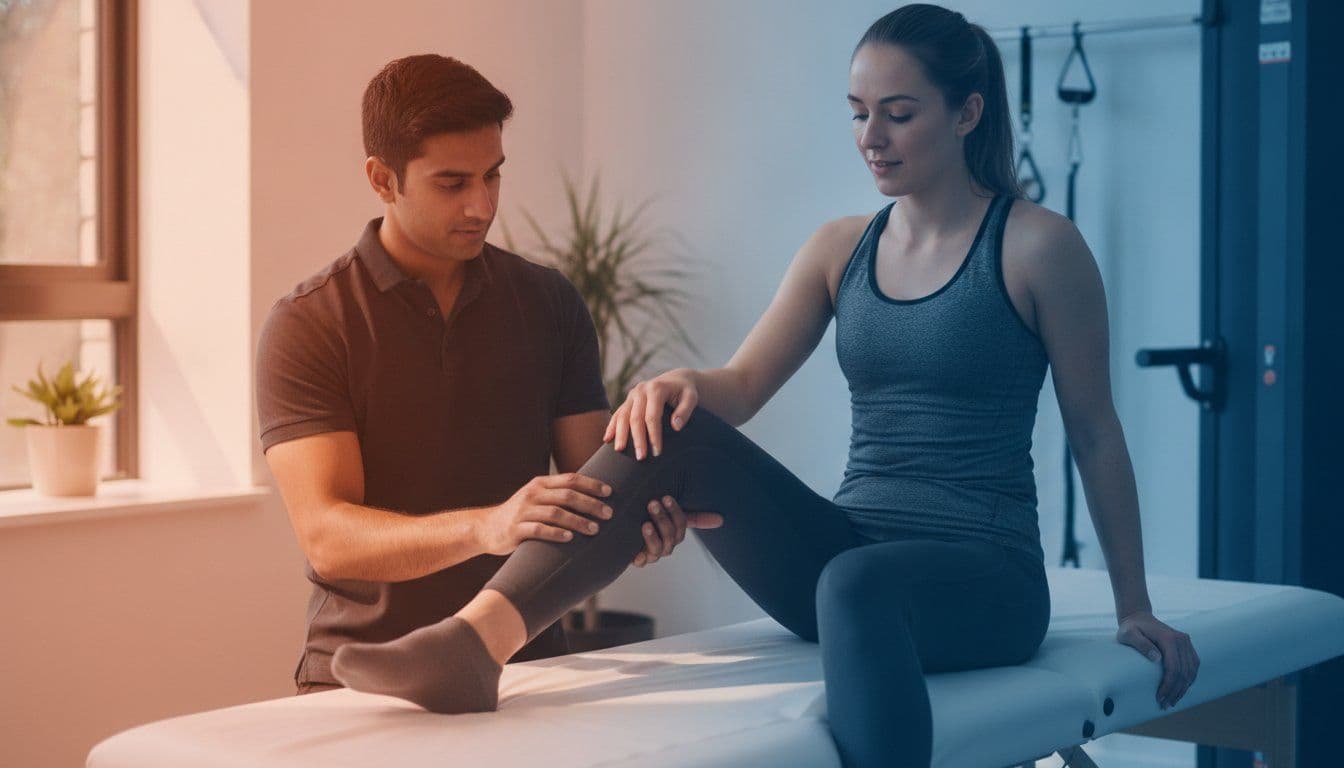
Fear of Re-injury After ACL Surgery: How to Reclaim Your Confidence
Struggling with the fear of re-injury after ACL surgery? Learn how our hands-on physio in Milton Keynes helps you trust your knee and get back in the game.
Did you know that nearly 45% of athletes who never return to their sport after a tear don't stop because of physical failure, but because of a mental hurdle? That nagging fear of re-injury after ACL surgery can make your knee feel like it's made of glass, even when your surgeon has given you the all-clear. It is incredibly frustrating to feel stuck with exercise-only rehab or slow NHS progress when all you want to do is pivot, jump, and get back in the game without that sinking feeling in your stomach.
I understand that recovery is as much about your brain as it is about your ligaments. In this guide, I will explain why your nervous system is working overtime to protect you and how a hands-on, proactive approach to physiotherapy can break that cycle of anxiety. You'll learn how to bridge the gap between basic movement and total match-day confidence. We're going to explore the brain-body connection and provide a clear path for you to return to football, rugby, or netball in Milton Keynes and Northampton with a knee you can actually trust again.
Key Takeaways
- Understand why your brain creates a fear of re-injury after ACL surgery as a protective mechanism and why it is a completely normal part of the recovery journey.
- Discover how "guarding" your knee can actually increase your risk of minor trips and learn how to retrain your nervous system to let go of that tension.
- Learn why hands-on therapy is the vital missing link in traditional "exercise-only" rehab for rebuilding both physical and mental trust in your joint.
- Identify the objective milestones, such as hop tests and strength scores, that provide the data-driven proof your knee is ready for the demands of competitive sport.
- Find out how to spot the signs that your current rehab has stalled and why a fresh, proactive approach is essential for getting you back on the pitch with total confidence.
Why Fear of Re-injury After ACL Surgery is Completely Normal
You have had the surgery, you have done the early stages of rehab, and the surgeon says the graft is solid. Yet, every time you think about a light jog or a change of direction, your brain screams "stop". This fear of re-injury after ACL surgery is not a sign of weakness; it is a deeply ingrained survival mechanism. Your brain is essentially trying to be a helicopter parent, hovering over your knee and refusing to let it take any risks. If you feel like your knee is made of glass, you aren't alone; research shows that up to 45% of athletes cite this exact fear as the main reason they don't return to their previous level of play.
In the clinical world, we refer to this as kinesiophobia. Understanding The Science of Kinesiophobia helps explain why your mind treats a perfectly healthy, reconstructed ligament as if it's made of glass. There is a massive difference between healthy caution, which keeps you from doing something reckless too early, and a debilitating fear that stops you from living. My job as your physio is to help you distinguish between the two so you can stop second-guessing every step you take.
The "Pop" That Stays With You
The trauma of an ACL tear is rarely just physical. That initial "pop" and the pain that followed created a powerful sensory memory in your nervous system. Even months later, certain sounds on the pitch or the feeling of your foot catching the turf can trigger an immediate "freeze" response. This anxiety often peaks between the 6 and 12 month mark, precisely when you're starting to feel physically stronger but haven't yet tested your knee in high-pressure situations. It's a normal part of the timeline, but it's a hurdle we need to clear together.
Is Pain Always a Warning Sign?
One of the biggest hurdles in overcoming fear of re-injury after ACL surgery is learning to read your body's signals again. Your nervous system has a habit of "turning up the volume" on minor sensations after a major trauma. You might feel a dull ache after a session or a bit of clicking, and your brain immediately jumps to the worst-case scenario. Most of the time, this is just "rehab ache", the sound of your muscles and tissues adapting to new loads. Part of our hands-on work involves desensitising these areas and teaching you to trust the high-quality hardware the surgeon put inside your knee.
The Science of Kinesiophobia: Why Your Brain Protects Your Knee
Your brain is effectively a high-tech security system that hasn't updated its software since the day you heard that dreaded "pop". When you experience a major injury, your nervous system creates a loop where fear leads directly to muscle guarding. You might notice your quads or hamstrings feel constantly tight, even when you are resting. This is your brain trying to "splint" the joint with muscle tension. Ironically, this guarding makes you more prone to minor trips or stumbles because your leg is too rigid to react naturally to the ground beneath you.
When you avoid certain movements, you are starving your brain of "safety data". Without the experience of moving without pain, your mind has no reason to believe the knee is stable. This is a primary driver for the fear of re-injury after ACL surgery. It's a cycle that keeps you stuck on the sidelines, even if your graft is technically perfect. To fix this, we have to prove to your nervous system that the knee can handle load without failing.
The Amygdala vs. The ACL
Think of your amygdala as a smoke alarm. After a trauma, that alarm is set to a hair-trigger sensitivity. It cannot distinguish between a controlled pivot in the clinic and the movement that caused your injury. To quiet this alarm, we have to work on your proprioception. This is your brain's internal GPS. If your brain doesn't know exactly where your knee is in space, it will always default to a state of high alert. We use specific movements to recalibrate this GPS, making you feel secure rather than vulnerable.
The Downside of Being Too Careful
Playing it safe often backfires. If you change your gait to protect your "bad" knee, you inevitably overload your hip or lower back. This often leads to secondary issues that make the recovery feel even more daunting. Studies on the psychological hurdles after ACL surgery highlight how these avoidance behaviours delay a return to sport indefinitely. Breaking the fear-avoidance cycle early is essential for a full recovery. If you want to move past these mental blocks and get back to your peak performance, exploring our specialised physiotherapy services is a great place to start.
Hands-On Recovery: Why Exercises Alone Aren’t Enough
If you have been handed a photocopied sheet of exercises and told to "get on with it", you know how isolating that feels. While building leg strength is a non-negotiable part of the process, it doesn't solve the fear of re-injury after ACL surgery on its own. Your brain needs physical, tactile confirmation that the graft is holding. This is why we prioritise hands-on treatment from day one. We use manual therapy to provide the "safety check" your nervous system craves, helping you move past the mental blocks that a gym-only approach often misses.
Manual therapy isn't just about making things feel a bit looser. It's a direct conversation with your nervous system. When we use joint mobilisations or soft tissue techniques, we are actively reducing the muscle guarding we discussed earlier. It is about proving to your brain that the knee is safe to use. This hands-on interaction builds a level of trust that simply cannot be achieved through a screen or a generic exercise plan. You aren't just another knee on a conveyor belt; you're an athlete who needs a bespoke plan to get back on the pitch.
Beyond the Gym Floor
Joint mobilisations and targeted soft tissue work do more than just improve flexibility. They give you the confidence to load the leg again. If you are searching for a physiotherapist near me, you likely want someone who actually puts their hands on the problem. Watching a video won't tell you if your patella is gliding correctly or if your hamstrings are overcompensating. During a hands-on session, you get immediate feedback. You feel the progress in real-time, which is the fastest way to quiet that inner voice telling you to be careful.
Fixing the Problem, Not Just the Symptoms
We don't believe in dragging out treatment for the sake of it. Our goal is to get you back to your sport as efficiently as possible with a clear, results-driven plan. Many of our patients in Milton Keynes and Northampton come to us because they are tired of the slow pace of NHS care or generic care. We offer transparent prices for private care that focuses on genuine results. It's about value for money and getting you back to the activities you love without the nagging fear of re-injury after ACL surgery holding you back. We focus on fixing the root cause, ensuring you have the autonomy to manage your health long after you leave our clinic.
Practical Steps to Reclaim Your Confidence on the Pitch
Recovery is not a straight line, but it should never be a guessing game. To move past the fear of re-injury after ACL surgery, you need a plan that addresses both the physical graft and the psychological hurdles. We use a method called "Graded Exposure". This involves taking the movements that make your stomach flip, such as pivoting or jumping, and breaking them down into tiny, manageable chunks. By doing the "scary things" in small doses, you prove to your nervous system that you are safe, one rep at a time.
Data is the best antidote to anxiety. We don't just ask how your knee feels; we measure it. By setting objective milestones, we give your brain the evidence it needs to relax. We look for specific markers before clearing you for the next stage of play:
- Limb Symmetry Index (LSI) of at least 90% in strength testing.
- Successful completion of a battery of hop tests.
- Agility scores that match your pre-injury performance.
- Confidence scores on validated psychological scales.
When you are back on the pitch, we use "external cues" to get you out of your own head. Instead of thinking about your knee position, we want you to focus on reaching for the ball or hitting a specific marker. This shift in focus allows your body to move more naturally and reduces the rigid "guarding" that often leads to stumbles.
Your 3-Step Confidence Roadmap
Step 1: Master the basics in a controlled environment. We start with linear movements, ensuring your landing mechanics are spot on. Step 2: Introduce "unpredictable" movements. This is where your physio will throw in reactive drills where you have to change direction on a whim. Step 3: Sport-specific drills. We recreate game-day pressure in the clinic, so the first time you face a defender, your brain has already "lived" it through mental rehearsal and visualisation.
Actionable Tips for Daily Progress
Keep a rehab diary to record your wins. When you feel like you're stalling, looking back at how far you've come is vital for motivation. Use the 24-hour rule to judge your load; if any ache or swelling settles within a day, you've hit the "sweet spot" of training. If nagging tendon pain is holding back your progress, we often use shockwave therapy to settle the tissue and get you back to loading with confidence. If you are ready to stop second-guessing every step, book your assessment with us today and let's get you back in the game.
When to Seek Help in Milton Keynes, Northampton, or Towcester
It is easy to tell yourself that you are just being sensible, but there is a fine line between being cautious and being stuck. If you have reached the nine-month mark and you are still hesitating before a simple pivot or avoiding a light jog, your recovery has likely hit a plateau. This lingering fear of re-injury after ACL surgery is a signal that your brain hasn't yet received the physical "proof" it needs to feel safe. A second opinion is vital if you feel your current rehab is stagnant or if you have been left to manage with nothing but a generic exercise sheet.
At RED Physiotherapy, we don't believe in "good enough" recoveries. We see patients from across Milton Keynes and Northampton who are physically strong but mentally held back by a lack of trust in their joint. Our approach is designed to bridge that gap efficiently. We provide a tailored plan that moves beyond basic strength, focusing on the high-level agility and reactive movements you actually need for game day. You shouldn't have to settle for a knee that feels like a liability; you deserve one that feels like a part of you again.
Signs You Need a Hands-On Intervention
If you are avoiding certain movements despite being nine months post-op, it is time for a fresh perspective. We often see athletes who feel "unstable" or "not quite right" despite having a clear scan from their surgeon. This is usually a sign that your proprioception needs fine-tuning through manual therapy and targeted drills. If you are frustrated by a lack of progress with your current conditions, a hands-on assessment can identify the subtle compensations that are keeping you in a cycle of fear.
Book Your Assessment Today
Our clinics in Milton Keynes, Northampton, and Towcester are run by a team of experts who understand the demands of competitive sport. We promise a hands-on approach from your very first session, focusing on real results rather than long-term, drawn-out treatment cycles. We are a family-run business that values genuine care and getting you back to your peak performance without the fluff. If you are ready to reclaim your confidence and stop letting the fear of re-injury after ACL surgery dictate your life, contact us today to book your assessment. Let's get you back to the sports you love with a knee you can finally trust.
Focus Keywords: fear of re-injury after ACL surgery, kinesiophobia, ACL reconstruction recovery, physiotherapy Milton Keynes, physiotherapy Northampton, physiotherapy Towcester, hands-on physiotherapy, return to sport after ACL.
It’s Time to Trust Your Knee Again
You have worked too hard on your recovery to let a mental hurdle keep you on the sidelines indefinitely. The key is to remember that the fear of re-injury after ACL surgery isn't a permanent state; it is simply a sign that your nervous system needs physical, hands-on reassurance. By moving away from generic exercise sheets and embracing a proactive, manual approach, you can finally quiet that inner alarm and move with freedom again.
Our expert team across Milton Keynes, Northampton, and Towcester is dedicated to fixing the root cause of your hesitation. We provide hands-on treatment from day one, using objective data and graded exposure to bridge the gap between "stable" and "match-fit". As a family-run practice, we care about your long-term autonomy and getting you back to the sports you love without the nagging worry of another tear. You don't have to settle for a knee that feels like a liability when you can have one you trust completely.
Book your hands-on ACL recovery assessment today and take the first step toward reclaiming your confidence on the pitch. We can't wait to see you back in action.
Frequently Asked Questions
Is it normal to be scared of re-injury 12 months after ACL surgery?
Yes, it is completely normal. Many athletes find that their physical recovery finishes well before their psychological one. This lingering fear of re-injury after ACL surgery often persists until you have successfully navigated high-pressure game situations. It is essentially your brain being overprotective, and it often requires specific, reactive training to prove to your nervous system that you are truly safe to play.
How do I know if my knee is actually unstable or if it is just fear?
Objective testing is the only way to be certain. True structural instability usually involves the knee "giving way" during basic tasks or persistent swelling after light activity. If your knee feels "loose" but holds firm during our clinical strength and hop tests, the issue is likely sensory rather than structural. We use hands-on assessments to confirm your graft is solid and your muscles are firing correctly.
Can physiotherapy help with the mental side of ACL recovery?
Absolutely, though many clinics unfortunately ignore this aspect. We bridge the gap between the gym and the pitch by using graded exposure to movements that make you feel anxious. By proving to your nervous system that your knee can handle load in a controlled setting, we quiet the "alarm" in your brain. This builds the trust you need to play without hesitation or "guarding" the joint.
What are the best exercises to build confidence in my knee?
Reactive drills with an "external focus" are the most effective for building confidence. Instead of just doing slow squats, we might have you catch a ball while landing or pivot on a whistle. These tasks force your brain to focus on the goal rather than the joint itself. This helps break the cycle of over-thinking your movements and makes your play feel natural and instinctive again.
Why does my knee feel stiff when I am stressed or anxious?
Your brain and body are on a two-way street. When you are anxious, your nervous system increases muscle tone as a protective measure, which you experience as physical stiffness. This is a classic symptom where the mind "splints" the joint to prevent perceived danger. Hands-on therapy helps to down-regulate this nervous system response and restore fluid movement by proving the joint is safe to move.
How long does it take to stop thinking about my knee during sports?
Most athletes report a "forgotten knee" feeling somewhere between 12 and 18 months post-op. However, this timeline depends heavily on the quality of your rehab. If you have only done linear gym work, you will likely still think about it when you pivot. A sport-specific plan that mimics game pressure in Milton Keynes or Northampton usually speeds up this mental transition significantly.
Should I wear a knee brace to feel more secure when returning to sport?
We generally advise against it unless there is a specific structural reason from your surgeon. Braces often act as a psychological crutch that prevents your brain from fully trusting your own muscles and ligaments. Our goal is to build a "natural brace" through elite-level strength and proprioception. We want you to step onto the pitch with total independence rather than relying on a strap-on support.
What happens if I feel a twinge during my rehab exercises?
Don't panic; minor twinges are a normal part of the fear of re-injury after ACL surgery journey. Most of the time, this is just "rehab ache" rather than any new structural damage. We follow the 24-hour rule. If the sensation settles within a day and there is no new swelling, you haven't done any harm. If you are ever unsure, a quick hands-on check-up can put your mind at rest.
Tags:
About the Author
Red Physiotherapy Team
Content Team
Health and wellness content from the RED Physiotherapy team.