
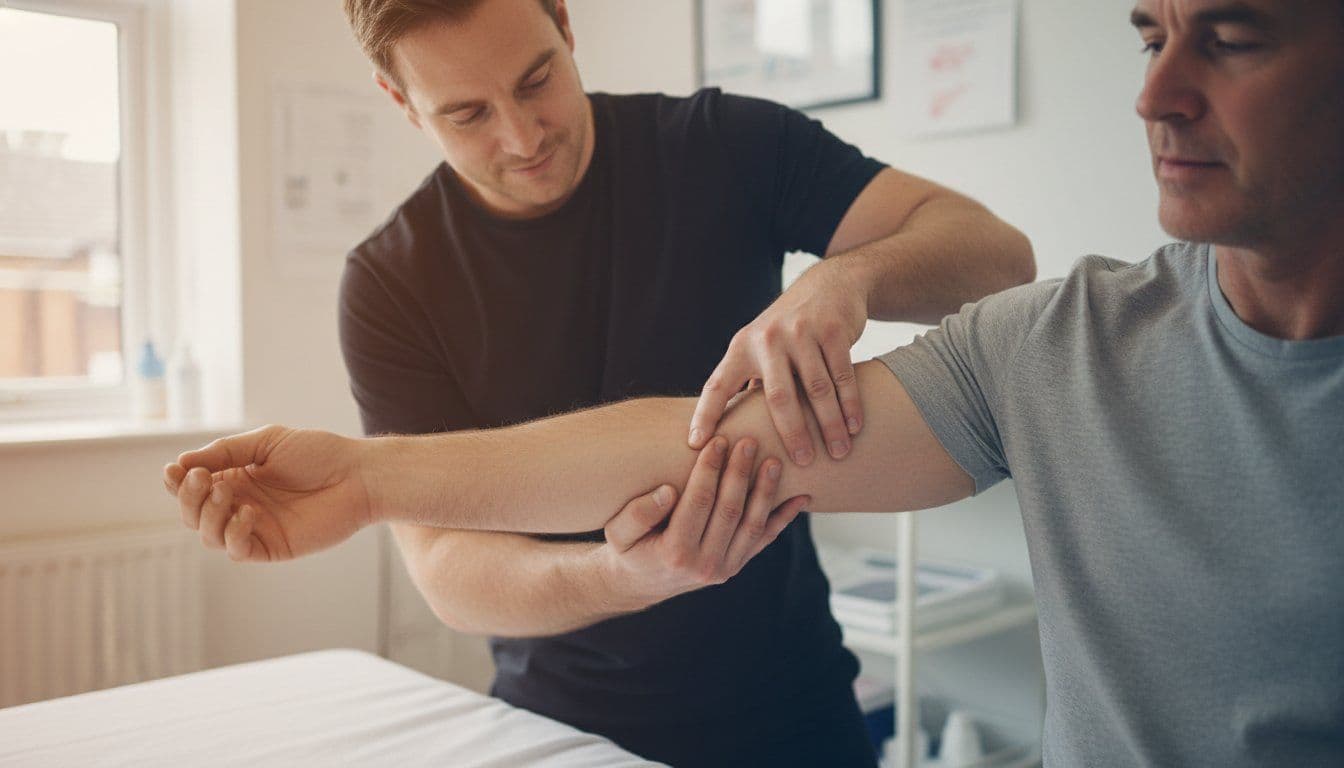
Golfer’s Elbow Physio in Northampton: Hands-on Relief for Persistent Pain
Searching for golfer's elbow physio in Northampton? Stop resting and start fixing. Our hands-on treatment finds the root cause for fast, lasting pain relief.
You might think that nagging pain on the inside of your elbow is just a simple tendon issue, but it's often a mechanical puzzle that starts as far away as your neck or shoulder. It's incredibly frustrating when you can't even grip a kettle or enjoy a Saturday morning round without that sharp, radiating ache down your forearm. If you've been searching for golfer's elbow physio Northampton, you're likely tired of resting and waiting for an NHS appointment, only to find that "rest" doesn't actually fix the underlying problem.
I'm here to show you how a targeted, hands-on recovery plan provides rapid relief and restores the strength you need for the gym, the garden, or the fairway. We'll explore why your elbow is shouting at you, how we use manual therapy to fix the root cause, and the clear steps we'll take together to get you back to your passions without the long waits. It's time to stop managing the pain and start solving it.
Key Takeaways
- Understand why your elbow pain is often a mechanical puzzle involving your neck and shoulder. We look at the whole kinetic chain to find the true source of your discomfort.
- Discover why seeking golfer's elbow physio Northampton at our clinic means receiving hands-on treatment from your very first session. We focus on manual therapy to get you moving rather than just handing over a sheet of exercises.
- Learn practical ergonomic tweaks for your home or office to reduce tendon strain immediately. These simple adjustments help protect your arm while you work toward full recovery.
- See a clear recovery roadmap that bypasses long waiting lists and gets you back to the gym or the garden faster. Identify the red flags that mean it's time to stop resting and start active treatment.
Understanding Golfer’s Elbow: Why It Is Not Just for the Fairway
Imagine waking up and reaching for your first cup of tea, only to feel a sharp, biting pain on the inside of your elbow. It isn't just a bit of morning stiffness. It's a persistent, nagging ache that makes even the simplest tasks feel like a total chore. If you've been searching for golfer's elbow physio Northampton, you're likely at the point where the pain is starting to dictate your day and stop you from doing what you love.
Clinically, we refer to this condition as medial epicondylitis. In plain English, it's an irritation of the tendons that join your forearm muscles to the bony bump on the inside of your elbow. To understand the mechanics of the condition, you can look at the clinical overview of What is Golfer's Elbow? on Wikipedia. Essentially, it's an overuse injury that occurs when these tendons are under more strain than they can handle, leading to micro-tears and a cycle of inflammation that just won't quit on its own.
You might be a regular at Brampton Heath Golf Club, but you're just as likely to develop this condition sitting at a desk in one of Northampton's business parks. Typing for eight hours a day or spending a weekend aggressively weeding the garden can trigger the same response as a repetitive golf swing. It's incredibly frustrating when basic movements, like carrying a heavy kettle or typing an email, suddenly become painful hurdles that you have to work around.
The Symptoms of Medial Epicondylitis
The most obvious sign is pinpoint tenderness right on that bony bump on the inner side of your elbow. You might notice your grip strength has gone to pot, making it hard to hold a gym weight or even a heavy shopping bag. Many of my patients find the stiffness is at its worst first thing in the morning. Finding effective golfer's elbow physio Northampton is about more than just managing the ache; it's about identifying why these symptoms are persisting. Sometimes the pain doesn't stay put. It can radiate down toward your wrist or creep up your arm, making your whole limb feel weak and unreliable.
Common Causes Beyond the Golf Course
Repetitive movements are the primary culprit. This includes anything from heavy lifting at work to the constant clicking of a mouse in a poorly set-up home office. We often see a spike in cases when someone suddenly increases their activity levels, like starting a new DIY project or hitting the gym too hard after a break. Poor ergonomics play a massive role too. If your desk setup in Northampton isn't supporting your forearms properly, those tendons are working overtime just to keep you productive. You can find more about how we categorise these issues on our conditions page.
Solving the Puzzle: Why Your Elbow Pain Might Start in Your Shoulder
The human body doesn't work in isolation. It operates as a kinetic chain, where every joint and muscle depends on its neighbour to share the physical load. If one link in that chain is weak or stiff, the others have to compensate. Most of the time, your elbow is simply the victim of a mechanical crime committed elsewhere in the arm. When you visit us for golfer's elbow physio Northampton, we don't just stare at the site of the pain. We put on our detective hats to see if your shoulder or neck is the actual culprit.
A stiff upper back is a classic example of this. If you can't rotate your torso properly, your elbow has to twist further to make up the difference during a gym session or a golf swing. Over time, this extra work leads to the micro-tears and irritation that keep you sidelined. We pride ourselves on finding these hidden mechanical links. Fixing the root cause is the only way to ensure the pain doesn't just come roaring back the moment you pick up a garden trowel or a tennis racket again.
The Role of the Ulnar Nerve
Sometimes, what feels like a pure tendon problem is actually a nerve in a spot of bother. The ulnar nerve runs right past that bony bump on your inner elbow, often called the "funny bone." If this nerve is irritated, it can mimic the symptoms of golfer's elbow or even occur alongside it. You might feel a strange pins and needles sensation or numbness in your ring and little fingers. During your first session, we'll assess how well that nerve is gliding. If it's snagged or compressed, rubbing the tendon won't do much to help.
Neck and Shoulder Connections
Your posture at a desk in the town centre can have a direct impact on your arm health. Slumping forward often compresses the tissues in your neck, which can refer pain all the way down to your elbow. Similarly, if your rotator cuff is weak, your forearm muscles have to grip twice as hard to stabilise whatever you're lifting. Understanding the causes of medial epicondylitis means looking at the whole picture. Our evidence-based assessment ensures we're treating the source, not just the scream. If you want to see how we tackle these complex issues, feel free to browse our comprehensive range of services.
Hands-on Treatment at Our Northampton Clinic: Fix the Root Cause
We don't believe in handing you a photocopied sheet of exercises and wishing you luck. If you're coming to see us for golfer's elbow physio Northampton, you're likely here because you want someone to actually fix the problem, not just talk about it. We pride ourselves on being a hands-on clinic from day one. While exercises have their place in the later stages of recovery, they often won't shift the stubborn, grumbly pain that stops you from comfortably gripping your car steering wheel or a tennis racket.
Our approach is about moving you through the recovery process efficiently. We don't drag treatment out for the sake of it. Instead, we use a blend of clinical expertise and modern technology to get you back to your best. By combining manual therapy with advanced diagnostics, we can pinpoint exactly why your tendon is struggling and apply the right pressure to get it healing again. It's about providing real results that you can feel before you even leave the clinic.
Manual Therapy and Soft Tissue Techniques
We get stuck in immediately with deep tissue work and sports massage to help reduce the tension in your forearm. These techniques aren't just about making you feel relaxed; they actively kickstart the healing process by improving local circulation. We also use specific joint mobilisations. These gentle, controlled movements help your elbow and wrist joints glide more freely, taking the mechanical stress off the irritated tendon. You can see the full range of what we offer on our services page.
Advanced Technology: Shockwave and Ultrasound
For those stubborn cases that have been lingering for months, shockwave therapy is often the game-changer you need. It uses acoustic pulses to stimulate blood flow and cell repair in damaged tendons that have effectively stalled in their healing. It's a fantastic, non-invasive option for chronic pain that hasn't responded to traditional rest.
We also use musculoskeletal ultrasound for pain right here in the clinic. Let's be honest, waiting for imaging on the NHS can be a long, frustrating game. With our diagnostic ultrasound, we can see exactly what is happening inside your arm in real-time. This means you get an accurate, fast diagnosis without the weeks of uncertainty. It allows us to build a recovery plan based on what is actually happening under the skin, rather than making a guess based on your symptoms alone.
Practical Advice: Managing Medial Epicondylitis at Home and Work
While we're busy sorting out the mechanical kinks in the clinic, there's plenty you can do at home to speed things along. One of the biggest mistakes people make is choosing total rest. If you stop using your arm entirely, the tendon becomes even less tolerant to load, making the pain more likely to return when you eventually pick up a tennis racket or a heavy shopping bag. Instead, we advocate for load management. This means staying active but staying below the threshold where your pain increases significantly or lingers into the next day.
Managing the daily grumble of golfer's elbow often comes down to simple temperature control. If your elbow feels hot and angry after a long day at the keyboard, ice is your best friend for ten minutes to calm things down. However, if you wake up feeling stiff and "cranky" in the morning, a bit of heat can help relax the muscles and improve blood flow before you start your day. These small habits provide the relief you need to stay productive while we work on the underlying golfer's elbow physio Northampton needs.
Ergonomic Tweaks for the Office
If you're based in Moulton Park, Brackmills, or any of the business hubs across Northampton, your desk setup might be the silent saboteur. A standard mouse forces your forearm into a palm-down position, which puts constant tension on those inner elbow tendons. Switching to a vertical mouse allows your arm to stay in a "handshake" position, which is far more natural. You should also check that your elbows are at a 90-degree angle and supported by your chair or desk. Don't forget to take "movement snacks" every hour. A quick thirty-second shake-out of your arms prevents the tissues from becoming glued in one position.
Simple Exercises to Start Your Recovery
You can start with a gentle wrist flexor stretch. Hold your arm out straight with your palm facing up, then use your other hand to gently pull your fingers back toward the floor. You should feel a pull, not a sharp pain. We also love isometric holds. This involves tensing the forearm muscles without actually moving the joint, like pushing your palm against a heavy table for thirty seconds. It's a safe way to keep the muscles "awake" without irritating the tendon. Remember, these are just to keep you ticking over. For a complete plan tailored to your body, book an assessment with us today.
When to Seek Help and Your Recovery Roadmap
It is a common mistake to wait until a small niggle becomes a major problem. While clinical data suggests that about 90% of people with medial epicondylitis make a full recovery within a year, that is a long time to spend struggling with a weak grip or a painful arm. Seeking golfer's elbow physio Northampton early can be the difference between a few weeks of targeted recovery and a year of frustration. If you ignore the pain, you are essentially allowing the tendon to continue its cycle of irritation, which often leads to a much longer and more complex recovery journey later on.
Our roadmap to recovery is designed to be efficient and transparent. We start with a deep dive into your history and a physical assessment to see if there is a mechanical cause in your shoulder or neck. Once we have a clear diagnosis, we move straight into hands-on treatment to settle the pain and improve mobility. As you start to feel the benefits, we shift the focus toward building long-term resilience. This ensures you don't just get better, but you stay better, with the strength to handle whatever your daily life throws at you.
Signs You Need a Professional Assessment
You should book an appointment if your elbow pain has lasted more than two weeks without showing signs of improvement. There are a few specific "red flags" that mean you shouldn't delay any further. If the pain is sharp enough to wake you up at night or if it prevents you from completing a normal day at work, it is time for a professional eye. Persistent numbness, a tingling sensation in your fingers, or a noticeable loss of strength when trying to open a jar are all signs that the ulnar nerve or the tendon is under significant stress.
Booking Your Session in Northampton
We know how frustrating it is to be stuck on a waiting list when you just want to get back to your life. You can contact us directly to skip the long waits and start your recovery immediately. We believe in being straight with our patients, which is why we offer transparent pricing so you know exactly where you stand from the start. Our goal is to help you reclaim your hobbies and your health. Whether you want to get back to the intensity of rugby at Franklin’s Gardens or just want to enjoy a peaceful weekend at the allotments without a throbbing arm, we are here to help you make that happen.
In summary, golfer's elbow is a manageable condition, but it requires a detective's eye and a hands-on approach to solve properly. By addressing the root cause, managing your daily load, and using modern technology like shockwave therapy, you can move past the pain. Don't let a temporary injury become a permanent limitation. Take the first step today, and let's get you back to full strength.
Focus Keywords
- golfer's elbow physio Northampton
Reclaim Your Strength and Get Back to Your Passions
You don't have to accept that nagging elbow ache as your new normal. Whether your pain started on the golf course or at your office desk, we've explored how this condition is often a mechanical puzzle that involves your neck and shoulder. By addressing the whole kinetic chain, we find the real reason your arm is shouting at you and fix it at the source. Our team provides hands-on treatment from your very first session, ensuring you get the relief you need without being fobbed off with just a sheet of exercises.
With diagnostic ultrasound and shockwave therapy available right here in the clinic, we offer the precision and speed that long waiting lists simply can't match. Our expert team uses years of clinical experience to build a recovery roadmap that fits your specific goals. If you're ready to stop managing the grumble and start fixing the cause, our golfer's elbow physio Northampton service is designed to get you moving again. It's time to reclaim your strength and get back to the activities you love, from the gym to the garden. Book your hands-on assessment in Northampton today and take that first step toward a pain-free life.
Focus Keywords
- golfer's elbow physio Northampton
Frequently Asked Questions
How many physio sessions will I need for golfer’s elbow?
Most patients start to feel a significant difference within four to six sessions. The exact number depends on how long you have been struggling with the pain and how grumbly the tendon has become. We don't believe in dragging treatment out for months. Our goal is to get you back to full strength as efficiently as possible with a clear, result-driven plan.
Is golfer’s elbow the same as tennis elbow?
No, they are essentially two sides of the same coin. Golfer’s elbow causes pain on the inside of the joint, while tennis elbow affects the outside. Both are types of tendon irritation caused by overuse or mechanical issues. Whether you have pain on the inside or outside, the hands-on approach we use at our clinic is designed to settle the irritation and fix the underlying cause.
Can I still go to the gym with golfer’s elbow?
Yes, you can usually stay active if you modify your routine. We rarely advocate for total rest because tendons actually need a bit of load to heal properly. We will show you how to adjust your grip or swap out certain exercises to keep you training without making the injury worse. Staying mobile is a key part of the golfer's elbow physio Northampton patients receive here.
Why is my elbow pain worse in the morning?
Tendons tend to stiffen up when they are stationary for long periods. Overnight, inflammatory chemicals can pool around the irritated area, making the joint feel stiff and "cranky" when you first wake up. Once you start moving and the blood starts pumping, the pain often eases off slightly. We use manual therapy to improve this local circulation and reduce that early morning bite.
Do I need a GP referral to see a physio in Northampton?
You do not need a referral from your doctor to book a session with us. You can simply get in touch and book your assessment directly, which is a massive help for those who want to avoid the long NHS waiting lists. Choosing golfer's elbow physio Northampton at a private clinic means you get hands-on treatment and expert advice from day one without the bureaucratic delays.
Will I need an injection for my elbow pain?
Injections are rarely necessary and are usually considered a last resort. Statistics show that 90% of people make a full recovery within a year using conservative, non-surgical treatments. We focus on manual therapy and shockwave therapy to stimulate natural healing first. These methods are often far more effective for long-term health than a temporary steroid fix.
How soon can I return to sport after starting physio?
You can often begin a graded return to sport within a few weeks of starting your treatment. While a full recovery can take longer, we don't want you sitting on the sidelines for months. We will provide a specific roadmap that tells you exactly when it is safe to pick up a club or a racket again. Our focus is on building a tendon that is strong enough to handle the pressure of competition.
Tags:
About the Author
Red Physiotherapy Team
Content Team
Health and wellness content from the RED Physiotherapy team.