
How to Stretch for IT Band Syndrome as a Northampton Runner
Struggling with outer knee pain? Discover the truth about IT band syndrome stretches for runners Northampton, smart rehab advice, and safe foam rolling tips.
A sudden increase in running load is a common cause of IT band syndrome, and stretching alone usually won’t solve it. For Northampton runners, IT band syndrome stretches may ease tightness around the hips and thighs, but the iliotibial band itself doesn’t stretch much. The most useful approach is to adjust the training that’s irritating your knee, then build strength and return to running gradually.
If an ache on the outside of your knee starts partway through a run, it’s understandable to reach for a stretch or foam roller and hope for a quick fix. This guide explains what may be causing the pain, which stretches and strengthening exercises may help, and when to ease off running. You’ll also learn how to use a foam roller without turning recovery into a battle with your thigh, so you can make a sensible plan to work towards running comfortably again.
Key Takeaways
- Look beyond stretching to spot training changes and movement habits that may be irritating the outside of your knee.
- Adjust your runs to keep activity manageable, and use your symptoms to guide when to ease back.
- Use stretching and foam rolling to support comfort, not as a way to force the IT band to lengthen.
- Get tailored physiotherapy advice if knee pain keeps returning or makes it difficult to run confidently.
What Causes IT Band Syndrome and How To Stop it?
Use these steps to map your symptoms, spot possible irritants and decide what to adjust. A simple run log can help reveal patterns.
- Recognise IT Band Symptoms
Record when discomfort starts, where it sits and what happens when you stop. IT band pain often develops on the lateral, or outer, side of the knee, sometimes 15 to 20 minutes into a run. Note whether it eases after stopping and returns on another outing. Also write down whether stairs or walking bring on symptoms. These details help distinguish a repeatable running pattern from a one-off ache. - Review Possible Causes
Compare painful runs with the route and movements involved. Downhill sections repeatedly bend your knee, while a cambered road can change your leg’s position with each step. One possible mechanism is compression of tissue between the iliotibial band and the lateral femoral condyle, the outer part of the thigh bone near the knee. The band runs along the outside of your thigh, from hip to knee. Don’t assume every ache on the outside of the knee has the same cause. - Check Training-Load Changes
Review your recent sessions and note any new hills, faster intervals, longer runs or extra training days. IT band syndrome is an overuse injury, and a sudden change in repeated loading may contribute. For example, record whether symptoms began after you added hill repeats, even if your weekly distance stayed similar. Adjust one aggravating factor at a time, then note how your knee responds on your next run.
Can I keep running with IT band syndrome?
You may be able to keep running by reducing distance and effort, provided you avoid sharp pain. A Northampton club runner, for example, could replace a hilly long run with shorter, flatter outings while symptoms settle.
- Weigh Stretching Against Strengthening
Use stretches if they ease tightness, but also include strengthening exercises for the hip muscles that help control your leg with each stride. For Northampton runners, IT band syndrome stretches may improve comfort, but they don’t replace strength work. Try controlled side steps and focus on steady movement instead of chasing a strong stretch. Don’t force the exercise if your knee still hurts. - Reduce running distance or frequency, then build up gradually. With moderate symptoms, two to three short runs per week may be more manageable than your usual schedule. Leave rest days between harder sessions, and use the 10% rule as a guide when increasing weekly mileage. If you tend to overstride, a 5 to 10% increase in cadence may help reduce irritation. Stop if sharp pain develops.
- Plan Recovery and Return to Running
Track how your knee feels during a run and afterwards. A mild injury may take two to four weeks to reach full recovery, while a severe injury may take nine to 24 weeks. These are recovery ranges, not fixed return dates. Resume distance gradually when your current running level is manageable, and avoid using a calendar deadline to push through symptoms.
If knee pain keeps disrupting your stride, this knee pain guidance can help you consider your next step.

Can you stretch the IT band with a foam roller?
A foam roller won’t meaningfully lengthen the iliotibial band, so don’t grind directly along it. Stretch nearby muscles gently, holding each stretch for 15 to 30 seconds and stopping if it causes pain or discomfort.
- Prepare for Safe Stretching
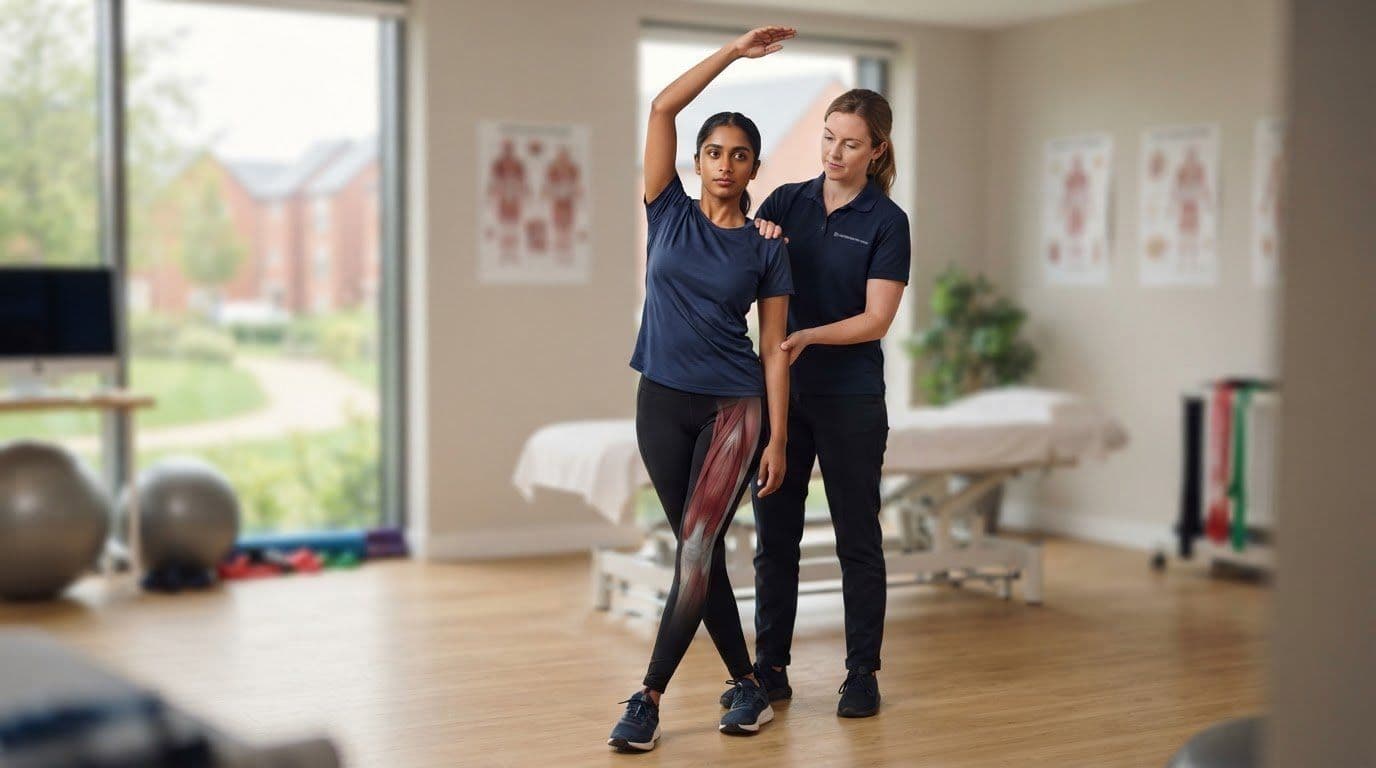
Choose a comfortable standing side stretch and move only until you feel mild tension, not pain. Hold for 15 to 30 seconds on each side, breathing normally rather than bouncing. If discomfort increases, ease out and stop that stretch. The aim is to move comfortably, not force the tissue into a new position. Try stretching the muscles around your hip and thigh instead of pulling hard on the band. - Foam Roll the TFL Muscle
Position the roller over the tensor fasciae latae, or TFL, at the front and outside of your hip. Roll gently for 30 to 60 seconds on each side, adjusting your position to find the muscle rather than pressing directly over the outer knee. You can also roll your glutes and quadriceps. Keep the pressure manageable, as more friction doesn’t mean better results. - Use Foam Rolling and Conservative Treatments
Roll your quadriceps, hamstrings, glutes and upper hip area once or twice daily if this eases muscle tension. Spend up to 10 minutes rolling the quadriceps, but stop if the pressure increases discomfort. Rest from movements that aggravate your knee, and return to activity gradually. Keep normally hydrated, too. Foam rolling may support comfort, but it won’t change the iliotibial band’s length; changing it by 1% requires more force than rolling can provide.
RED Physiotherapy: Physiotherapy
RED Physiotherapy can help if outer-knee pain keeps returning, limits your runs or leaves you unsure how to progress. Physiotherapy looks beyond the sore spot, taking your symptoms, running movement, training changes and strength needs into account. You’ll receive a plan tailored to your goals, which may include hands-on treatment and exercises to build your running capacity. Stretching and foam rolling may ease discomfort, but they might not address the factors that keep irritating your knee.
If you’re in Northampton and adjusting your training hasn’t settled the problem, physiotherapy can help you understand what to change and how to build back towards running. You don’t need to arrive with the perfect diagnosis or exercise routine. Contact RED Physiotherapy to discuss your next step.
Make your next run a confident step forward
Returning to running is about more than getting through the next kilometre. It’s about finding a routine that supports the miles you enjoy and helps you feel confident in your choices. For Northampton runners, IT band syndrome stretches are one part of the process, not a test of how much discomfort you can tolerate. If knee pain keeps disrupting your plans, a tailored assessment can help you decide what to do next.
RED Physiotherapy can help you build a plan around your movement and running goals. You don’t have to work it all out alone. Contact RED Physiotherapy for support and take a steady step towards running with more confidence.
Frequently Asked Questions
What exercises help with IT band syndrome?
Hip and glute strengthening exercises can help improve control during running. Try clamshells or resistance band side steps, keeping each movement controlled rather than rushing through repetitions. A resistance-band side-step drill may be a useful way to work the hips and glutes, provided you can perform it comfortably and with control. Choose exercises you can perform with good form, then build difficulty as they become easier.
What is your IT band?
Your IT band, or iliotibial band, is a thick strip of connective tissue that runs from your hip towards the outside of your knee. It attaches to the thigh bone at several points, which helps explain why stretching or rolling directly over it won’t lengthen it much. Movement and strengthening exercises can still target nearby muscles, including the glutes.
What else can treat an IT band injury?
Alongside adjusting aggravating activity, an ice pack may ease soreness around the outer knee after a run. Apply it for 10 to 15 minutes, with a layer between the pack and your skin. Cross training can help maintain activity whilst you reduce impact. If pain persists or affects everyday movement, physiotherapy can assess your symptoms and guide your next steps.
Can I run through IT band syndrome pain?
Don’t push through sharp pain or keep running if you change your stride to protect your knee. Stop the session and choose a comfortable alternative, such as low-impact cross-training. If discomfort returns at the same point in successive runs, note the distance and route. That record can help you adjust your training more precisely.
Do you need to rest completely?
Not necessarily. If symptoms are manageable, reducing your running and staying active with comfortable alternatives may be more practical than stopping all movement. More severe symptoms may call for a short break from running, while aqua jogging can help maintain running fitness during recovery. Let your pain and ability to move normally guide your activity rather than forcing a fixed training plan.
Tags:
About the Author
Red Physiotherapy Team
Content Team
Health and wellness content from the RED Physiotherapy team.