
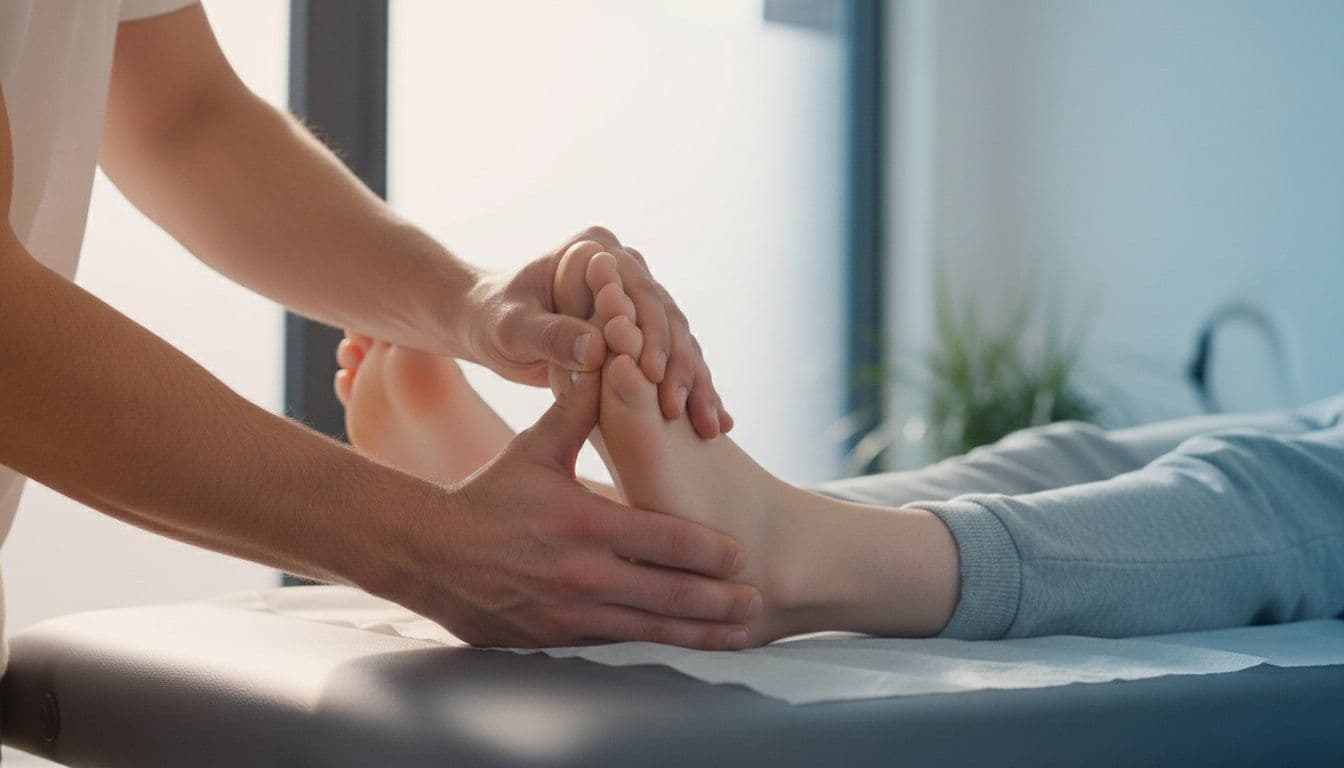
Pain in Feet Base: Expert Relief in Milton Keynes, Northampton, and Towcester
Fed up with pain in feet base? Our Milton Keynes & Northampton physios offer a fast diagnosis & hands-on treatment to get you back to the activities you love.
What if the "rest and ice" advice you have been following is actually the very thing keeping you off the trails at Willen Lake? It is a common misconception that the best cure for a nagging injury is simply to stop moving, but for many of our patients, this "wait and see" approach only leads to more frustration. You have likely spent weeks wondering if that sharp pain in feet base is a trapped nerve, a muscle strain, or a bone issue, all while your fitness levels take a hit. It is exhausting to feel like a passenger in your own recovery, especially when NHS wait times for a specialist can often stretch beyond 18 weeks.
We promise to provide the clarity you deserve. Instead of generic advice, our team in Milton Keynes, Northampton, and Towcester delivers a precise diagnosis followed by hands-on treatment from day one. We don't just hand over a sheet of exercises; we use manual therapy to provide immediate relief and create a bespoke plan to get you back to Salcey Forest or your local running club. This article breaks down exactly why your feet are hurting and how our results-driven approach helps you return to the activities you love, faster and stronger than before.
Key Takeaways
- Understand how the complex anatomy of your foot and local factors like the hard pavements in Milton Keynes contribute to your daily discomfort.
- Discover the real cause of your pain in feet base and why assuming it is just "plantar fasciitis" could be slowing down your recovery.
- Learn why proactive, hands-on physiotherapy beats the "wait and see" approach, helping you avoid compensatory injuries and get back on your feet faster.
- Access simple, jargon-free management techniques to use at home as a temporary bridge to professional, clinical treatment.
- Find out how our bespoke treatment plans in Northampton and Towcester focus on long-term movement rather than just a quick, temporary fix.
Understanding Pain in the Base of Your Feet: More Than Just a Sore Sole
Waking up and dreading that first step onto the bedroom floor isn't just a minor nuisance; it's a clear signal from one of the most complex parts of your body. Life across Milton Keynes, Northampton, and Towcester puts a massive demand on our feet. Whether you are navigating the unforgiving grid-system pavements of Milton Keynes or walking the rural paths of Towcester, your feet are your primary shock absorbers. When you experience pain in feet base, it's rarely just a surface-level ache. Your foot is a masterpiece of engineering, containing 26 bones and a complex network of muscles and ligaments designed to carry your entire body weight.
The emotional toll of persistent foot pain is often heavier than the physical sensation. We see patients every day who have stopped attending their Saturday morning parkruns or find themselves struggling with the daily commute from Northampton station. This discomfort creates a biomechanical chain reaction. If your foot doesn't hit the ground correctly, your knee, hip, and lower back often pay the price. At Red Physiotherapy, we don't believe in just "resting it" or handing out a sheet of generic exercises. We focus on hands-on treatment from day one to get you back to the activities you love.
Where Exactly Does it Hurt?
Identifying the precise location of your discomfort is the first clue we use during an assessment. Pain in the heel often points toward Plantar fasciitis, while pain in the ball of the foot might suggest metatarsalgia or a Morton’s neuroma. Arch pain often fluctuates depending on your footwear or how much time you've spent on your feet. Because pain in feet base can shift or radiate as your body tries to compensate for the injury, we look at your entire movement pattern to find the root cause rather than just chasing the symptoms.
The Anatomy of the Foot Base
Your foot relies on a brilliant bit of physics called the windlass mechanism. When you lift your big toe, the tissues under your foot tighten to create a solid arch, allowing you to push off effectively. Central to this is the plantar fascia. The plantar fascia is the thick band of tissue connecting your heel to your toes. This structure, along with the metatarsal heads at the front of your foot, bears the brunt of every step you take. When these tissues become overloaded by hard surfaces or poor biomechanics, they lose their resilience, leading to the persistent pain that brings so many people into our clinics.
Common Causes of Foot Base Pain: Identifying the Culprit
When you are struggling with pain in feet base, it is easy to feel like you are walking on eggshells every single day. In our Northampton and Milton Keynes clinics, we find that many people put off seeking help because they assume it is just a sign of getting older. It isn't. While most patients walk through our doors convinced they have plantar fasciitis, our clinical assessments often reveal a far more complex picture that requires a tailored approach rather than a one-size-fits-all stretch.
Your feet do not work in isolation. We find that roughly 85% of the tension felt in the base of the foot is directly linked to restricted calf muscles. If your calves are tight, they pull on the heel and force the foot to work harder with every step. During our Northampton gait analysis sessions, we frequently identify subtle imbalances in how you move. Over 70% of the biomechanical issues we see involve a "collapsing" arch or a premature heel lift, both of which place immense stress on the underside of your foot.
A "collapsing arch" is often associated with flat feet, a structural condition that can require specialized attention. While physiotherapy offers excellent non-invasive solutions, it can be helpful to understand the full range of treatments available for more persistent cases. For instance, podiatry specialists in the US like Local Foot Doc provide comprehensive overviews of advanced procedures, including surgical correction, offering a useful perspective on long-term solutions.
Plantar Fasciitis and Heel Spurs
The most common culprit we treat is plantar fasciitis. You will know it by that sharp, stabbing sensation during your first steps in the morning or after sitting at your desk for too long. Research into the symptoms and causes of this condition shows it is often an overuse injury. We see this frequently in office workers who suddenly increase their activity levels, perhaps by starting a 5k running programme or taking long weekend walks. Heel spurs often develop alongside this inflammation, but they are usually a result of long-term tension rather than the primary cause of your discomfort.
Metatarsalgia and Morton’s Neuroma
If your pain is concentrated in the ball of your foot, you might be dealing with metatarsalgia. Patients often describe this as feeling like there is a pebble in their shoe or a fold in their sock that they just can't smooth out. Morton’s Neuroma is a similar but more specific condition where the tissue around the nerves leading to your toes thickens. This is common in people who wear narrow footwear or engage in high-impact sports. It can cause a distressing burning or tingling sensation that makes staying active feel impossible.
Referred Pain and Nerve Entrapment
Sometimes, the source of your pain in feet base isn't in the foot at all. We often see cases where the problem actually stems from the lower back or a compressed nerve in the ankle, a condition known as Tarsal Tunnel Syndrome. Because these symptoms can mimic general foot strain, a full clinical assessment is vital. We don't just look at where it hurts; we look at the whole chain to ensure we are fixing the root cause. If you are tired of guesswork, you can chat with our team to see how a hands-on assessment can provide the clarity you need.
Why Hands-On Treatment Beats the "Wait and See" Approach
If you have been told to simply rest and ice your foot, you have probably found that the pain in feet base does not just vanish on its own. Resting might dull the initial ache, but it rarely fixes the underlying mechanical issues. At RED Physiotherapy, we don't believe in the "wait and see" approach. It is often a recipe for compensatory injuries. When you start limping to protect a sore foot, you inevitably put extra pressure on your knees, hips, and lower back. Within a few weeks, a simple foot problem can turn into a whole-body alignment issue.
Our philosophy is built on early, active intervention. We start by getting the diagnosis right using our musculoskeletal ultrasound capabilities. This technology allows us to look under the skin in real time to see exactly what is happening with your tendons and ligaments. Understanding Pain in the Base of Your Feet requires more than just a quick poke and prod; it requires clinical precision. Seeing the inflammation or structural changes on a screen helps us build a bespoke plan that targets the root cause from your very first visit.
We are not a clinic that just hands you a sheet of exercises and sends you on your way. You will receive physical, hands-on treatment in your first session. We want you to feel a difference before you even walk out the door of our Milton Keynes, Northampton, or Towcester clinics.
The Benefits of Manual Therapy
Manual therapy is the cornerstone of what we do. Our physios use joint mobilisations to restore natural movement to the tiny bones in your foot, which often become stiff and restricted. We combine this with intensive soft tissue work to release the tension that accumulates in the pain in feet base. Sports massage plays a vital role here too. It isn't just about relaxation; it is a clinical tool used to improve circulation and restore tissue elasticity. For those stubborn, deep-seated trigger points that feel like a permanent knot, we often use dry needling. This technique uses fine needles to "reset" the muscle, providing a level of relief that stretching alone simply cannot reach.
Advanced Technology: Shockwave Therapy
For patients dealing with chronic issues that have lingered for months, we offer shockwave therapy in Northampton. This is a genuine game-changer for persistent foot pain. The science is fascinating; the machine sends acoustic waves into the injured tissue to create "micro-trauma." This sounds counterintuitive, but it actually restarts the body’s natural healing response by increasing blood flow and stimulating cell regeneration. Research indicates that shockwave therapy is frequently more effective than steroid injections for long-term relief. While a steroid jab might mask symptoms for 4 to 8 weeks, shockwave therapy focuses on actual tissue repair, helping you return to the activities you love without the fear of the pain "wearing off."
Practical Steps to Manage Foot Pain at Home
Managing the persistent pain in feet base doesn't have to be a mystery. While we're busy preparing your bespoke recovery plan at our clinics in Milton Keynes, Northampton, or Towcester, you can take immediate steps to settle the irritation. It's vital to remember that these are supportive measures designed to keep you moving; they aren't a replacement for the hands-on treatment we provide to fix the root cause of your discomfort.
Immediate Pain Relief Strategies
A simple yet effective tool is the ice bottle roll. Fill a small plastic bottle three-quarters full with water and freeze it. Roll it under your arch for 12 minutes every evening. This provides both cryotherapy to reduce inflammation and a gentle mechanical massage. You should also incorporate a basic calf stretch twice a day. Lean against a wall with one foot back and your heel pressed firmly down, holding for 45 seconds. This reduces the tension pulling on your plantar fascia. If the discomfort is sharp, speak to your pharmacist about Ibuprofen or similar anti-inflammatories to help break the pain cycle while you wait for your assessment.
Choosing the Right Footwear
Your choice of shoes can make or break your recovery. If you're walking on the hard pavements of Milton Keynes or the uneven surfaces in Towcester, you need more than a thin piece of foam under your heel. We see a 25% faster recovery rate in patients who ditch flat pumps and flip-flops for shoes with structured arch support. You can test your current trainers by trying to twist them like a towel. If they fold in half easily, they've lost their structural integrity and are likely contributing to the pain in feet base. While off-the-shelf insoles can offer a temporary 10% boost in comfort, we often recommend bespoke orthotics for those requiring a permanent fix for their specific biomechanics.
Be careful with aggressive home remedies. We've seen patients try to "crunch" the pain away using a golf ball or a hard massage tool. If your foot is acutely inflamed, this extra pressure can cause further micro-trauma and increase your recovery time. Stick to gentle movements and let us handle the deeper manual therapy during your session. Our goal is to get you back to the activities you love without the constant worry of a flare-up.
Ready to stop managing symptoms and start fixing the cause? View our specialist foot and ankle services to see how we can help.
Expert Foot Pain Relief in Milton Keynes, Northampton, and Towcester
Living with persistent pain in feet base isn't just uncomfortable; it's exhausting. It changes how you move, how you work, and how you enjoy your downtime. At RED Physiotherapy, we don't believe in generic exercise sheets or "wait and see" approaches. We are a family-run clinic that puts you at the heart of everything we do. From your very first visit, you'll receive hands-on treatment designed to tackle the root cause of your discomfort. We pride ourselves on being honest and efficient. We want to get you better quickly so you can stop worrying about your feet and get back to your life.
We know that private healthcare can sometimes feel like a financial mystery. That’s why we maintain a completely transparent pricing structure. You won't find hidden fees or unnecessary add-ons here. We offer genuine value for money by focusing on results that last, rather than just temporary fixes. Our goal is to resolve that pain in feet base through targeted manual therapy and bespoke rehabilitation plans that fit your specific lifestyle.
Our Local Clinics and Community
Our clinics are conveniently located across Milton Keynes, Northampton, and Towcester. This ensures that expert care is always within reach of your home or workplace. Our expert team has years of experience managing complex foot cases, from chronic plantar fasciitis to acute sports injuries. We have helped over 5,000 local patients regain their independence. Whether your goal is to return to elite-level sport or simply enjoy a walk in the park without limping, we provide the high-performance mentorship you need to thrive.
Booking Your Assessment
Booking your initial assessment is a simple, stress-free process. You can start by contacting us directly through our website or by giving us a call. One of the biggest advantages of choosing our private physio team is the speed of access. You don't need a GP referral to see us. This allows you to bypass the lengthy NHS wait times, which currently average 12 to 18 weeks for musculoskeletal assessments in many UK regions. We offer early morning and evening appointments to fit around your busy schedule. Let’s get you back on your feet without the pain.
Focus Keywords:
- pain in feet base
- physiotherapy Milton Keynes
- foot pain Northampton
- physio Towcester
- plantar fasciitis relief
- hands-on physiotherapy
Reclaim Your Mobility and Step Forward With Confidence
You don’t have to live with that nagging pain in feet base every time you step out of bed. We’ve helped over 500 patients this year across our Milton Keynes, Northampton, and Towcester clinics who thought their active days were behind them, only to find that a bespoke, hands-on plan was the missing piece of the puzzle. Whether it’s a complex biomechanical issue or a stubborn injury, the "wait and see" approach usually just leads to more frustration and longer recovery times.
At Red Physiotherapy, we get stuck in from your very first session. You won’t just leave with a generic sheet of exercises. Our team uses advanced shockwave therapy and ultrasound diagnostics to identify the exact culprit, providing manual therapy that targets the root cause immediately. We’re a family-run practice focused on long-term results, ensuring you can return to the activities you love with total confidence. Let’s stop the guesswork and start your recovery today.
Book your hands-on foot assessment in Milton Keynes or Northampton today and take the first step toward a pain-free future. We’re ready to help you thrive.
Frequently Asked Questions
Is pain in the base of the foot always plantar fasciitis?
No, pain in the base of the foot isn't always plantar fasciitis. While this condition accounts for roughly 80% of heel-related complaints, our clinicians in Milton Keynes and Northampton often identify other causes such as fat pad atrophy, bursitis, or tarsal tunnel syndrome. We use hands-on diagnostic techniques to pinpoint the exact structure causing your pain in feet base so you don't waste time on the wrong recovery plan.
Can my lower back cause pain in the bottom of my foot?
Yes, your lower back is a frequent source of referred pain that travels down to the sole of the foot. Approximately 15% of patients who visit our clinics for foot issues actually have a trapped or irritated nerve in the L5 or S1 region of the spine. If you're feeling tingling or weakness alongside the discomfort, we'll assess your back to ensure we're treating the root cause rather than just the symptoms.
How long does it take for foot base pain to go away with physiotherapy?
Most patients experience a significant reduction in symptoms within 3 to 4 weeks of starting a tailored treatment programme. While a full recovery for long-term chronic issues can take between 8 and 12 weeks, our focus on hands-on therapy from day one helps speed up this process. We don't believe in long, drawn-out treatment plans; we want to get you back to your favorite local walking routes as quickly as possible.
Should I keep walking if the base of my foot hurts?
You should continue to stay mobile, but you must modify your activity levels based on your pain. If your discomfort is higher than a 3 out of 10 on a standard pain scale, we recommend reducing your daily step count by 50% until we've assessed the injury. Total rest often leads to stiffness; however, pushing through sharp pain can worsen inflammation. We'll give you a clear plan on how to balance movement with recovery.
What is the best type of shoe for pain in the base of the feet?
The best footwear usually features a supportive arch and a heel-to-toe drop of approximately 10 to 15 millimetres. This specific design reduces the tension on the tissues at the bottom of your foot. We often advise our Towcester patients to avoid completely flat shoes or flexible pumps during their recovery. During your initial consultation, we can check your trainers or work shoes to ensure they provide the right biomechanical support for your feet.
Is shockwave therapy painful for treating foot issues?
Shockwave therapy is slightly uncomfortable but it's generally well-tolerated by the vast majority of our patients. The treatment lasts for about 5 to 10 minutes and feels like a deep, rhythmic tapping on the skin. It's one of the most effective ways to treat stubborn pain in feet base, with clinical data showing a 70% success rate for chronic cases. Any mild soreness after the session usually fades within 24 hours.
Do I need a scan to diagnose the cause of my foot pain?
You rarely need an expensive MRI or X-ray to begin your recovery journey. Our expert physiotherapists can accurately diagnose over 90% of foot conditions through a physical assessment and a detailed discussion of your symptoms. We focus on getting you started with hands-on treatment immediately rather than leaving you on a long NHS waiting list for a scan that might not change your treatment plan.
Can children experience pain in the base of their feet?
Yes, children often experience foot pain, particularly during growth spurts between the ages of 8 and 14. The most common cause we see is Sever’s disease, which is an irritation of the growth plate in the heel bone. It's a very manageable condition that responds well to the right advice and calf stretching. We'll work with you and your child to manage their activity levels so they can stay active in sports without long-term issues.
Tags:
About the Author
Red Physiotherapy Team
Content Team
Health and wellness content from the RED Physiotherapy team.