
Woman's Shoulder Tip Pain: Causes, Referred Pain, and How to Find Relief
Experiencing woman shoulder tip pain? It might not be your shoulder. Learn the real causes, from referred pain to red flags, and find fast, hands-on relief.
What if that sharp, stabbing sensation at the very top of your shoulder has absolutely nothing to do with your shoulder joint at all? For many, woman shoulder tip pain feels like a deep, unreachable ache that doesn't care how much you rest or stretch. It's an unsettling experience that often brings a fair amount of anxiety, especially when the discomfort feels more like an internal "hitch" than a simple pulled muscle.
We agree that it's incredibly frustrating when your body starts sending confusing signals that don't respond to standard self-care. This article promises to decode those signals, explaining why shoulder tip pain is often a "smoke signal" from the phrenic nerve rather than a local injury. You'll learn how to distinguish between a medical emergency and a case for hands-on physiotherapy. We'll also provide a clear, evidence-based plan to move you from uncertainty toward a full recovery, helping you return to the activities you love in Milton Keynes, Northampton, and Towcester without the constant worry.
Key Takeaways
- Learn how to distinguish between a simple muscle strain and deep referred pain by identifying the exact location where your arm meets your shoulder.
- Discover why woman shoulder tip pain is often a "smoke signal" from internal organs like the gallbladder or liver rather than a local injury.
- Understand the common musculoskeletal culprits such as rotator cuff impingement and bursitis that cause sharp, localized discomfort.
- Recognise the critical red flags that require urgent medical attention, including the link between shoulder pain and specific women's health issues.
- Find out how a hands-on clinical approach can bypass long NHS wait times and fast-track your recovery with a tailored, expert-led plan.
What Exactly is Shoulder Tip Pain and Why Does it Happen?
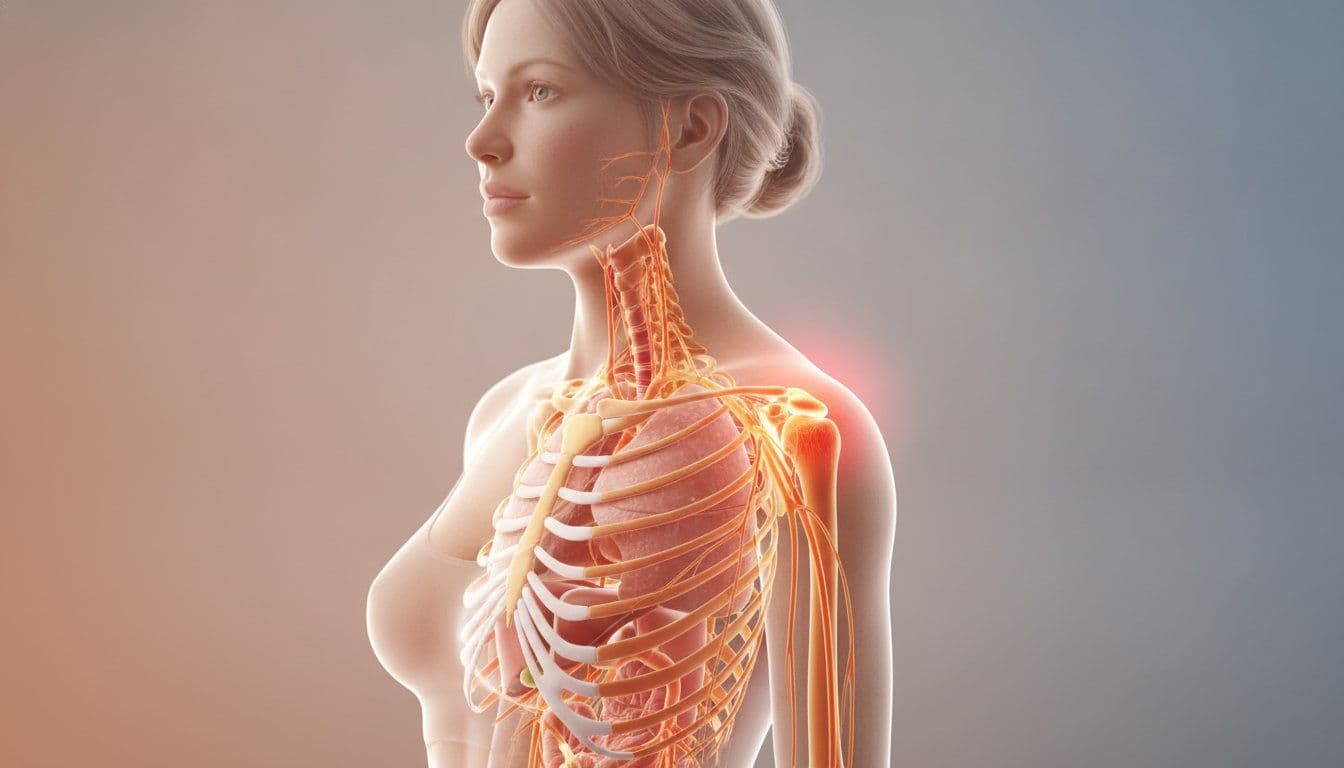
When we talk about shoulder pain, most people think of a pulled muscle from a heavy gym session or carrying bags of shopping. However, woman shoulder tip pain is a different beast entirely. It is located precisely at the acromion, the bony point where your arm meets your shoulder. Unlike a standard muscle strain, this pain often feels deep and unreachable, as if it is coming from inside the bone itself rather than the tissue on top.
If you find that your discomfort flares up when you take a deep breath or lie flat at night, you aren't imagining things. This specific sensation is often a "referred" pain, meaning the source of the trouble is actually somewhere else in your body. Your brain is simply misinterpreting the signals. At our clinics in Milton Keynes and Northampton, we often see patients who are worried because their pain doesn't respond to typical rest or ice. Understanding the difference between a local mechanical issue and this deep, radiating pain is the first step toward getting the right treatment.
Identifying the Location of Your Discomfort
To figure out what is going on, we often use the "pointer test." If you can put one finger exactly on the spot that hurts and it feels tender to the touch, you are likely dealing with a local musculoskeletal issue, such as a ligament or tendon problem. If the pain feels like it is "everywhere and nowhere" at the top of your shoulder, or if the skin isn't actually sore when you press it, the cause is likely internal. This anatomical landmark is unique because it serves as a crossroads for several major nerve pathways, making it a prime spot for the body to broadcast "smoke signals" from other areas.
The Phrenic Nerve: The Body's Internal Alarm
The phrenic nerve is the primary messenger for this specific type of discomfort. It travels from your neck, specifically the C3 to C5 vertebrae, all the way down to your diaphragm. If something in your abdomen irritates the diaphragm, the signal travels back up this nerve line. Because the nerve roots for the shoulder and the diaphragm are so close together in the spinal cord, your brain can get confused. It assumes the pain is coming from the shoulder tip. This phenomenon is known clinically as Kehr's sign. In women, this pathway is particularly active due to the proximity of the reproductive organs and the way the body processes internal inflammation. It’s a clever biological alarm system, but it can be incredibly distressing if you don't know why it's happening.
Referred Pain vs. Local Injury: Differentiating the Cause
Distinguishing the root of woman shoulder tip pain requires a bit of detective work. Mechanical pain is usually quite logical. If you lift your arm to reach for a cup of tea and feel a sharp pinch, you are likely looking at a local injury like a tendon strain. Referred pain, however, is far more sneaky. It tends to be constant, a dull but intense ache that doesn't change when you move your arm. It might even flare up after a heavy meal or while you are simply sitting still.
Abdominal and Diaphragmatic Triggers
The right shoulder is a common landing spot for pain signals originating in the gallbladder or liver. When these organs are inflamed, they irritate the diaphragm, which then sends a distress signal up the phrenic nerve. This is why unexplained shoulder pain can sometimes be linked to digestive issues rather than a gym injury. You might notice the sensation intensifies when you take a deep breath or cough, as these actions physically move the diaphragm against the irritated organ. If your shoulder pain is accompanied by bloating or discomfort in your upper abdomen, the "fire" is likely in your belly, not your joint.
Post-Surgical Shoulder Pain in Women
If you have recently had keyhole surgery for something like endometriosis or a gallbladder removal, you might be surprised to find your shoulder hurts more than your incisions. During laparoscopic procedures, surgeons use CO2 gas to inflate the abdomen. This gas can get trapped under the diaphragm, putting direct pressure on the phrenic nerve. It is a very common phenomenon in women's health procedures. This pain usually peaks about 24 to 48 hours after surgery and dissipates as the body absorbs the gas. We suggest gentle movement, like walking around the house or performing light pelvic tilts, to help the gas move along and relieve the pressure.
At our clinics in Milton Keynes, Northampton, and Towcester, we don't just hand you a sheet of exercises and send you on your way. We take a detailed clinical history to find the "hidden" cause of your discomfort from day one. If you are struggling to make sense of your symptoms, our physiotherapy services offer a hands-on approach to get you back to your daily routine without the guesswork.
Common Musculoskeletal Causes of Shoulder Tip Pain
If your pain isn't coming from an internal organ, it's likely a mechanical issue within the joint itself. While referred pain feels deep and vague, musculoskeletal pain is usually sharper and tied to specific movements. These mechanical issues frequently cause woman shoulder tip pain, often involving the structures that keep the joint stable. You can find a full list of Shoulder pain causes on MedlinePlus, but in the clinic, we see a few usual suspects quite regularly.
The most frequent culprits include:
- Rotator cuff impingement. This happens when the tendons in your shoulder get "nipped" or pinched by the bones as you lift your arm.
- Subacromial bursitis. A small, fluid-filled sac called a bursa sits at the tip of your shoulder to reduce friction. If it becomes inflamed, even small movements can feel like a hot needle.
- AC joint strain. The acromioclavicular joint is where your collarbone meets your shoulder blade. It's a common site for woman shoulder tip pain, especially if you've been lifting heavy weights or carrying a toddler on one side.
Rotator Cuff and Tendon Issues
Tendon issues range from mild inflammation to small tears. A telltale sign of a rotator cuff problem is "night pain." You might find it impossible to get comfortable when lying on the affected side, or the ache might wake you up at 3 am. Unlike the NHS "wait and see" approach, we use hands-on therapy from day one. By manually releasing the tight structures around the joint, we can take the pressure off those nipped tendons and get you moving again.
The Role of Posture and Ergonomics
We see a lot of office workers from Milton Keynes and Northampton who suffer from "office shoulders." If you spend eight hours a day hunched over a laptop, your head naturally drifts forward. This creates massive tension at the very top of your shoulder blades and the acromion. This postural fatigue isn't just about "bad habits." It's a physical overload of the muscles. Simple adjustments, like raising your monitor so your eyes hit the top third of the screen or using a separate keyboard, can make a world of difference. At RED Physiotherapy, we don't just give you a list of exercises. We treat the immediate pain with hands-on techniques and then build a plan to stop it coming back. Check out our conditions page to see how we tackle these postural issues.

When to Seek Help: Red Flags and Professional Advice
Not all cases of woman shoulder tip pain are created equal. While many instances are mechanical issues we can resolve quickly in the clinic, some types of pain are urgent "smoke signals" from the body that require immediate medical attention. Distinguishing between a "niggling" muscle strain that hurts when you reach for a shelf and "emergency" pain that feels deep, cold, or unrelenting is a vital skill for your long-term health.
Medical Emergencies You Shouldn't Ignore
If your shoulder pain arrives suddenly alongside chest tightness, shortness of breath, or a cold sweat, you must call 999 or head to A&E. These are classic, albeit sometimes subtle, signs of a heart attack or pulmonary embolism. For women, there is another critical red flag to keep in mind. If you have had a positive pregnancy test and experience sudden, sharp pain at the very tip of your shoulder, seek medical help immediately. This is a primary indicator of a ruptured ectopic pregnancy, where internal bleeding irritates the diaphragm and sends a distress signal up the phrenic nerve. This isn't a time for "wait and see"; it's a time for professional intervention.
The Advantage of Early Physiotherapy
Once you have ruled out a medical emergency, the focus shifts to efficient recovery. Relying on the NHS for musculoskeletal issues can be a test of patience, with median wait times for treatment starting at 11.9 weeks as of June 2026. Waiting three months for an assessment often leads to compensatory injuries. You might start holding your neck stiffly or changing the way you sit to avoid the ache, which only creates more problems in your back and joints.
At our family-run clinics in Milton Keynes, Northampton, and Towcester, we believe in a hands-on approach from your very first session. We don't just hand you a generic sheet of exercises and send you home. We use advanced diagnostic tools, including musculoskeletal ultrasound for pain, to see exactly what is happening beneath the skin. Getting a professional clinical diagnosis within the first 48 hours provides immense peace of mind and allows us to start active, manual treatment immediately. This proactive management is the fastest way to restore your movement and get you back to your daily activities without the frustration of long-term discomfort.
If you're tired of the "wait and see" approach and want a clear, expert plan to resolve your discomfort, book an assessment with our team today and take the first step toward a pain-free life.
The RED Physiotherapy Approach to Shoulder Recovery
If you are struggling with woman shoulder tip pain, you need more than a generic PDF of stretches and a "wait and see" attitude. At RED Physiotherapy, we are a family-run practice that believes in a hands-on approach from your very first session. We know that when you are in pain, you want clarity and physical relief immediately, not a three-month wait for a phone consultation. Our clinics across Milton Keynes, Northampton, and Towcester are designed to be welcoming spaces where you are treated as a partner in your recovery, not just another number on a spreadsheet.
What sets us apart is our specialist team. We have dedicated experts in Women's Health who deeply understand the complex referred pain patterns unique to the female body. Whether your shoulder pain is a mechanical joint issue or a "smoke signal" from an internal trigger, we have the clinical expertise to identify the root cause and start fixing it on day one.
Hands-On Treatment and Real Results
We are not an "exercises-only" clinic. While movement is vital for long-term health, we know that manual therapy is often the key to breaking the cycle of acute pain. We use a variety of evidence-based techniques, including manual joint mobilisations and dry needling, to desensitise painful areas and restore normal tissue tension. By focusing on the root cause rather than just chasing the symptom, we ensure that your recovery is efficient and sustainable. Our rehabilitation programmes are entirely personalised, moving away from generic exercise sheets to focus on the specific demands of your life and body.
Your Journey to Movement Autonomy
The ultimate goal of our treatment is to return you to your personal passions with total confidence. Recovery isn't just about the absence of discomfort; it's about reaching your full physical potential. Whether you want to get back to competitive sport, enjoy an afternoon in the garden, or simply get through a long office day in Milton Keynes without a stabbing pain in your shoulder, we build the strength and resilience you need to stay pain-free. We focus on long-term autonomy, giving you the tools and proactive management strategies to look after your body long after your last session. Your journey starts with a thorough clinical assessment, and you can book yours at our Northamptonshire or Milton Keynes clinics today to finally get the answers you deserve.
Take Control of Your Recovery Today
Understanding that woman shoulder tip pain isn't always a simple muscle strain is the first step toward getting your life back. Whether the cause is a "nipped" rotator cuff tendon, postural fatigue from office work, or a referred "smoke signal" from your abdomen, you deserve a diagnosis that doesn't involve a three-month wait. We've explored how identifying the root cause, from the phrenic nerve to surgical gas, allows for a much faster and more effective recovery plan.
At RED Physiotherapy, our family-run team in Milton Keynes, Northampton, and Towcester is ready to help you move beyond generic exercise sheets. We provide hands-on treatment from your very first session, using our specialist Women's Health expertise to ensure you aren't just managing symptoms but fixing the problem for good. Don't let uncertainty or physical limitations hold you back from your daily passions any longer.
Book your hands-on shoulder assessment at RED Physiotherapy today and let's get you back to your best. We are here to support your journey to long-term strength and movement autonomy with a plan that actually works.
Frequently Asked Questions
Can menopause cause shoulder tip pain in women?
Menopause is a frequent cause of joint and tendon discomfort. Declining oestrogen levels affect the collagen in your tendons and the lubrication within your joints, which can lead to increased inflammation or even "frozen shoulder." At our clinics in Milton Keynes, we often see women in this life stage who find their shoulder tip feels stiff and achy without a specific injury. Hormonal changes essentially make the joint structures more vulnerable to irritation.
Why does my shoulder tip hurt when I take a deep breath?
Pain during a deep breath is a classic sign of referred pain via the phrenic nerve. Your diaphragm and shoulder share the same nerve pathway. When you inhale deeply, your diaphragm moves, and if it is irritated by internal inflammation or trapped gas, your brain misinterprets the signal as woman shoulder tip pain. It is a clever but annoying biological "crossed wire" that requires a clinical assessment to decode.
Is right shoulder tip pain different from left shoulder tip pain?
The side of the pain matters quite a bit for a professional diagnosis. Right-sided pain often points toward gallbladder or liver irritation, while left-sided pain can be linked to the spleen or occasionally the heart. However, mechanical issues like rotator cuff tears or bursitis can happen on either side. We use hands-on assessments at our Northampton practice to determine if the issue is a local musculoskeletal problem or a referred signal.
How can a physio tell if my pain is referred from my gallbladder?
We play detective during your first session. If your shoulder discomfort doesn't change when we move your arm or press on the joint, but flares up after a fatty meal, it is likely referred from the gallbladder. We also check for tenderness in the upper abdomen. If the shoulder joint itself feels "quiet" but the pain is loud and constant, the source is likely internal rather than a mechanical injury.
Can a trapped nerve in my neck feel like shoulder tip pain?
Your neck and shoulder are very closely linked. A trapped or irritated nerve in the lower cervical spine, specifically at the C4 or C5 levels, often sends sharp, electric-like sensations right to the acromion at the top of your shoulder. You might also feel tingling or weakness further down your arm. We use manual therapy to offload the neck and see if that "switches off" the discomfort in your shoulder tip.
What is the fastest way to get rid of shoulder tip pain after surgery?
Movement is your best friend after keyhole surgery. The CO2 gas used during the procedure needs to be absorbed or dissipated by your body. Gentle walking and light shoulder rolls help move the gas along and reduce pressure on the phrenic nerve. Some women find that applying a heat pad to the shoulder tip helps desensitise the area while the body processes the surgical gas, which usually settles within 72 hours.
Should I use heat or ice for pain at the top of my shoulder?
The choice depends on the underlying cause. If you have just "nipped" a tendon and the area feels hot or swollen, ice is the best choice for the first 48 hours to calm inflammation. For deep, achy referred pain or "office shoulders" caused by postural fatigue, heat is much more effective. It helps relax the surrounding muscles and improves blood flow to the area to speed up your natural healing.
Will sports massage help with referred shoulder tip pain?
Sports massage is brilliant for relaxing the tight muscles that often tense up as a secondary reaction to pain. However, if the discomfort is referred from an internal organ, massage won't fix the root cause. At RED Physiotherapy, we combine hands-on soft tissue work with a full clinical diagnosis. This ensures we aren't just rubbing the "smoke" while the "fire" is still burning elsewhere, providing you with a more sustainable recovery.

Tags:
About the Author
Red Physiotherapy Team
Content Team
Health and wellness content from the RED Physiotherapy team.