
Physiotherapy Treatment Plan for Runner’s Knee: Your Roadmap to Pain-Free Miles
Get a clear physiotherapy treatment plan for runners knee in Milton Keynes. Ditch the wait and get hands-on care to run pain-free. Your recovery starts here.
You are standing at the top of the stairs, and that familiar, dull ache behind your kneecap makes you wince before you have even taken the first step. It is incredibly frustrating to feel your hard-earned fitness slipping away while you are stuck on an endless NHS waiting list, wondering if you will ever get back to your local running club. You need more than just a "rest and see" approach; you need a proactive physiotherapy treatment plan for runners knee that starts with hands-on clinical care from day one.
We agree that waiting months for a referral while your trainers gather dust is simply not an option. That is why we provide a clear roadmap to get you back to your personal best in Milton Keynes, Northampton, and Towcester without the fluff. In this article, we will preview the essential steps of a professional recovery, from expert gait analysis and biomechanical assessment to the specific manual therapies we use to settle your pain fast. You will discover how to stop the cycle of injury and rebuild your confidence, ensuring your next run is defined by your pace, not your pain.
Key Takeaways
- Understand why runner's knee is rarely just about the knee and how identifying biomechanical leaks in your hips can transform your running gait.
- Explore our structured physiotherapy treatment plan for runners knee that moves from immediate pain relief to high-level performance training.
- Learn why hands-on clinical treatment is far more effective than a generic PDF of exercises for calming down an irritated joint.
- Discover the four essential phases of recovery that help you transition safely from the treatment table back to your local running club.
- Recognise the warning signs that indicate you need a professional assessment in Milton Keynes or Northampton to prevent a long-term injury.
What is Runner’s Knee? Understanding Patellofemoral Pain
If you have ever felt a nagging, dull ache right behind your kneecap after a loop around Willen Lake or a jog through Northampton, you are likely dealing with What is Runner’s Knee?. Clinically, we call it Patellofemoral Pain Syndrome (PFPS). In plain English, it means the back of your kneecap is getting a bit irritated with the thigh bone it sits on. It isn't a sign that your knee is "broken" or that you need a replacement. It is simply a mismatch between the load you are putting through the joint and what your muscles are currently capable of handling. If you want to learn more about how we categorise these issues, you can check our conditions page.
You might notice the discomfort most when walking down stairs, which often feels significantly worse than going up. There is also the classic "movie-goer’s knee" where your joint feels stiff and achy after sitting in the cinema or at your office desk for too long. These symptoms are common, but they are also fixable. It is a mechanical issue that responds brilliantly to the right intervention. A tailored physiotherapy treatment plan for runners knee is designed to bridge that gap between your current capacity and your running goals.
Why is my kneecap acting up?
Think of your kneecap like a train on a track. It needs to slide smoothly up and down a groove in your thigh bone as you move. If the "track" is slightly off or the muscles pulling the train are unbalanced, we get what is known as maltracking. This isn't usually a structural disaster; it is often triggered by a sudden spike in mileage or a change in running terrain. When the mechanics are slightly off, the joint surface gets grumpy, leading to that persistent ache. This is why a bespoke physiotherapy treatment plan for runners knee is so vital. We need to find exactly where your specific "track" is misaligned.
Common myths about runner’s knee
One of the biggest mistakes people make is thinking that total rest is the cure. While a few days off might settle the initial flare-up, rest alone doesn't fix the underlying weakness or gait issue. You don't have "bad knees" just because they hurt right now. In fact, most people with PFPS can return to full strength with the right guidance. Another common trap is relying on generic knee sleeves. While they might feel snug, they are often just a temporary placebo. They don't address why the pain started in the first place. Real progress comes from a structured plan that combines hands-on therapy with progressive loading.
The Root Causes: Why Your Running Form Matters
While the pain is shouting at you from your kneecap, the real culprit is often hiding elsewhere. In our clinics, we look for biomechanical "leaks" where energy isn't being managed properly. Think of your body as a chain; if one link is loose, the knee often ends up doing the heavy lifting. Understanding the causes of runner's knee involves looking at how you move as a whole. This is why a generic plan fails. Your "why" is unique to your body and your training history, and without a specific diagnosis, you are just guessing. It is much better to identify the source of the problem early than to let it linger.
Your hips and glutes act as the steering wheel for your legs. If they aren't firing correctly, your knee loses its primary support system. Similarly, if your feet are collapsing inward through overpronation, they effectively "twist" the knee from below. Every step you take during a 5k run involves thousands of repetitions of these movements. If those repetitions are slightly off, the joint surface becomes overloaded. A professional physiotherapy treatment plan for runners knee must identify these specific leaks before we even think about increasing your mileage. We often see that approximately 1 in 4 runners will experience this issue, so you are certainly not alone in this struggle.
The "Hip-Knee-Ankle" connection
A common finding in our clinics is a weak gluteus medius. When this muscle is lazy, your hip drops and your knee "caves in" toward the midline, a movement we call valgus. This puts immense pressure on the patellofemoral joint. Tight calves also play a part by limiting your ankle’s range of motion. A stiff ankle forces the knee to work harder by absorbing impact it was never meant to handle. This chain reaction is precisely why we assess your entire leg rather than just poking the bit that hurts.
The importance of a professional gait assessment
To get to the bottom of your pain, we use a running gait analysis to see exactly how you interact with the ground. We aren't just looking at your trainers; we are watching your cadence, where your foot strikes, and whether your pelvis stays level. Small tweaks, such as slightly increasing your step rate to reduce overstriding, can immediately take the pressure off your kneecap. If you are struggling to make progress on your own, it might be time to chat with us about a bespoke assessment. We focus on fixing the root cause so you can return to the trails with confidence.
The RED Difference: Why We Don’t Just Give You a PDF of Exercises
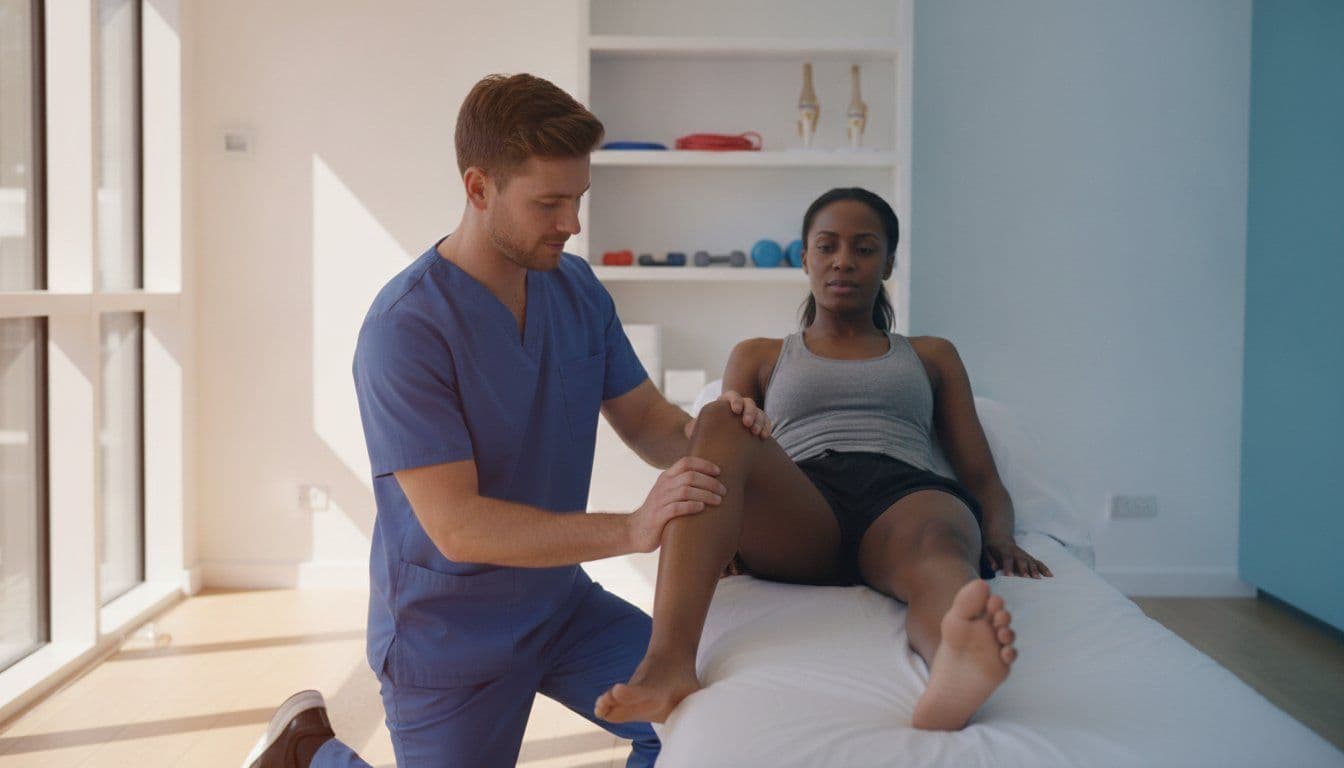
We have all been there. You wait weeks for an appointment only to be handed a generic, photocopied sheet of leg lifts and told to come back in a month. At RED Physiotherapy, we think that is a bit rubbish. A truly effective physiotherapy treatment plan for runners knee requires more than just homework. It needs hands-on clinical care from your very first visit. We don't just want to tell you what to do. We want to actively help your body feel better so you can actually perform the movements that will fix the problem for good.
While the NHS often relies on a "wait-and-see" model, our approach is proactive. We use manual therapy to "quiet down" an irritated nervous system. When your knee is in a state of high alarm, even the best exercises can feel painful or impossible to complete. By using clinical techniques to settle the joint, we create a vital window of opportunity. This allows you to start strengthening the right muscles without the constant "ouch" factor. It positions you as an active partner in your recovery, working through a clear, time-bound plan rather than just hoping for the best. You can read more about Patellofemoral Pain Syndrome (Runner's Knee) to understand why this multi-faceted approach is so widely recommended by specialists.
Hands-on clinical intervention
Our sessions often involve targeted sports massage to release tension in the quads and IT bands. These muscles often become overactive when the knee is struggling. We also utilise dry needling to deactivate stubborn trigger points that might be referred from your hips or thighs. These hands-on methods aren't just about temporary comfort. They are strategic tools used to reset your biomechanics and prepare your body for the harder work of rehabilitation. We want your physiotherapy treatment plan for runners knee to feel like a collaboration, not a lecture.
Fixing the problem, not just the symptoms
We are not interested in the "revolving door" of temporary fixes. Our goal is long-term autonomy and sustainable wellness. This means we don't just treat the bit that hurts; we look at why it started hurting in the first place. Our expert team comes from a background in elite sports and family-run care. We know that if we don't address the root cause, you will be back on the treatment table in six months. By focusing on your specific goals, whether that is a 5k PB or just walking the dog without a limp, we ensure your recovery is built to last.
Your 4-Phase Physiotherapy Treatment Plan for Runner’s Knee
Recovery isn't just about waiting for the pain to stop; it is about building a body that can handle the miles ahead. A professional physiotherapy treatment plan for runners knee should follow a logical progression that respects your body’s healing timelines. We don't believe in guesswork. We follow a structured roadmap that ensures each stage of your recovery builds upon the last, taking you from the treatment table back to your favourite trail in Milton Keynes or Northampton.
- Phase 1: Pain Modulation and Load Management. Our first priority is to calm things down. We use hands-on techniques to settle the irritation and help you find a "safe" level of movement that doesn't flare up your symptoms.
- Phase 2: Targeted Strengthening. Once the "fire" is out, we start building the foundation. This focuses on the glutes, quads, and calves to ensure your knee has the support it needs to track correctly.
- Phase 3: Impact Loading and Plyometrics. Running is essentially a series of single-leg hops. We introduce controlled impact exercises to teach your tendons and joints how to absorb and release energy efficiently again.
- Phase 4: Return to Performance. This is the final stretch. We use gait retraining and a structured mileage build-up to get you back to your local running club with a technique that prevents the pain from returning.
Advanced treatments for stubborn cases
Sometimes, a standard exercise plan isn't enough for chronic issues. For those stubborn cases, we might incorporate shockwave therapy to kickstart the healing process in the surrounding tendons. We also use musculoskeletal ultrasound to see exactly what is happening under the skin, allowing for a pinpoint diagnosis. These technologies don't just provide answers; they significantly accelerate your recovery timeline by ensuring we are treating the right tissue with the right method from day one.
Essential exercises (The RED way)
We move far beyond the basic squat. To fix runner's knee, you need movements that challenge your stability and control, such as split squats, lateral step-downs, and glute bridges. We also place a heavy emphasis on "isometric" holds for tendon health. Holding a wall squat is often far more effective for an angry knee than banging out 50 reps because it builds strength while avoiding the repetitive friction that keeps the joint irritated. If you are ready to stop guessing and start a structured physiotherapy treatment plan for runners knee, we are here to help you take that first step toward pain-free miles.
When to Seek Professional Help in Milton Keynes & Northampton
It is incredibly tempting to think that a few days of rest and a bag of frozen peas will solve the problem. However, ignoring the underlying cause is usually how a minor niggle turns into a season-ending injury. If you have been searching for a physiotherapy treatment plan for runners knee, it is likely because the pain has already started to interfere with your weekly mileage or your ability to tackle the stairs after a long day at the office. We believe that early intervention is the key to a fast and sustainable recovery.
We see many runners in our Milton Keynes and Northampton clinics who waited far too long to seek advice. Running through the pain is a recipe for a 6-month layoff. When you try to "tough it out," your body naturally shifts the load to other joints to protect the knee. This inevitably overloads your hip or ankle, creating a whole new set of problems that could have been avoided. A proactive approach doesn't just fix the knee; it protects your entire kinetic chain from further breakdown.
Choosing a family-run practice like RED means you get genuine care and a clear plan of action from people who actually know your name. We aren't a large corporate chain where you are just another slot in a crowded diary. Our team focuses on fixing your problem efficiently rather than dragging out your recovery process. We want to see you back at the start line of your next local race, not stuck in our waiting room. Our clinics in Milton Keynes, Northampton, and Towcester are designed to get you moving again without the frustration of long wait times.
Signs you need a physio, not just a rest
How do you know when it is time to call in the experts? Look out for these specific red flags that suggest your knee needs more than just a weekend off:
- Pain that persists for more than 48 hours after your run has finished.
- Obvious swelling around the kneecap or a strange "locking" or "catching" sensation when you move.
- Pain that is severe enough to change how you walk or force you to alter your running gait.
If you are experiencing any of these symptoms, a professional assessment is essential. A tailored physiotherapy treatment plan for runners knee will identify if the issue is a simple mechanical tweak or something that requires more intensive intervention, such as shockwave therapy or gait retraining.
Ready to get back on the road?
Taking the first step toward recovery is often the hardest part of the journey. Whether you visit us in Milton Keynes, Northampton, or Towcester, we provide honest advice and a clear path forward. We believe in being transparent with our patients, which is why you can find our straightforward pricing online before you even step through the door. There are no hidden fees or "revolving door" treatment schedules here.
You don't have to accept knee pain as an inevitable part of being a runner. With the right hands-on treatment and a progressive plan, you can return to your local club stronger and more confident than before. Your next PB is waiting. Let’s go get it.
Get Back to Your Personal Best
Runner's knee is a sign that your body's capacity and training load are out of sync, but it is certainly not a permanent sentence to the sidelines. By understanding the mechanical root causes and following a structured physiotherapy treatment plan for runners knee, you can bridge the gap between where you are now and where you want to be. It's about moving from a state of frustration to a place of physical potential.
Our family-run practice prioritises hands-on treatment from day one, ensuring you get relief from that nagging ache while we work on your long-term stability. With specialist running gait analysis available at our clinics in Milton Keynes, Northampton, and Towcester, we take the guesswork out of your recovery. We don't just give you a PDF; we partner with you to rebuild your confidence and your stride. Don't let a dull ache turn into a six-month layoff when expert help is just around the corner.
Book Your Gait Assessment & Treatment at RED Physiotherapy Today
Your next finish line is closer than you think. We're here to help you move from the treatment table back to the trails. Let's get you back on the road together.
Frequently Asked Questions
How long does a physiotherapy treatment plan for runner’s knee take?
Most mild to moderate cases see a significant improvement within 2 to 4 weeks when following a professional physiotherapy treatment plan for runners knee. If you choose to manage the injury yourself, recovery often takes 4 to 8 weeks, while leaving it untreated can lead to a layoff of 12 weeks or more. We focus on fast results by using hands-on therapy from your first visit to speed up the healing process.
Can I keep running while I have runner’s knee?
You don't always have to stop running entirely, but you will likely need to modify your training. We often recommend active recovery where we adjust your mileage and intensity rather than demanding total rest. If your pain is low and doesn't linger for more than 24 hours, we can usually find a "safe" distance for you. Total rest can actually weaken your muscles, making your return to the trails in Northampton much harder.
Is sports massage effective for runner’s knee?
Sports massage is a brilliant tool for reducing muscle tension and "quieting down" an irritated nervous system. While it won't fix a biomechanical leak on its own, it releases tight quads and IT bands that often pull the kneecap out of alignment. This creates a vital window of opportunity, allowing you to perform your strengthening exercises without pain. It is a core part of our hands-on approach at RED Physiotherapy.
What is the best exercise for runner’s knee?
There isn't one single "perfect" exercise because your physiotherapy treatment plan for runners knee must be tailored to your specific weaknesses. However, we often start with isometric wall sits because they build strength without the repetitive friction of movement. From there, we progress to split squats and lateral step-downs to target the glutes and quads. These movements ensure your kneecap tracks correctly during every stride.
Do I need an MRI for my knee pain before seeing a physio?
You rarely need an MRI before starting treatment with us. A thorough clinical assessment and gait analysis in our Towcester or Milton Keynes clinics are usually enough to identify the source of the problem. MRIs often show "wear and tear" that isn't actually causing your current pain. If we do suspect something more complex, we can use musculoskeletal ultrasound in-house to get a clearer picture without the long NHS wait times.
Why does my knee hurt more when I run downhill?
Running downhill puts significantly more stress on the patellofemoral joint because your quads have to work harder to "brake" your descent. This eccentric loading increases the pressure between your kneecap and your thigh bone. If your quads or glutes are a bit weak, the joint takes the brunt of that force. We can help you tweak your technique and build the specific strength needed to manage these downhill forces better.
How is runner’s knee different from a meniscus tear?
Runner's knee is typically a dull, aching pain felt behind or around the kneecap that worsens with stairs or sitting. A meniscus tear usually feels more "inside" the joint and is often accompanied by sharp pain, swelling, or even the knee "locking" in place. While runner's knee is a mechanical loading issue, a meniscus tear involves the cartilage pads. We use specific clinical tests to differentiate between them during your assessment.
Will I need to wear a knee brace forever?
You definitely won't need a brace forever. While a sleeve can provide a bit of confidence and warmth during the early stages of recovery, it is really just a temporary aid. Our goal is to build your internal "brace" by strengthening the muscles that support the knee joint. Once your glutes and quads are doing their job properly, you can ditch the neoprene and trust your body to handle the miles on its own.
Tags:
About the Author
Red Physiotherapy Team
Content Team
Health and wellness content from the RED Physiotherapy team.