
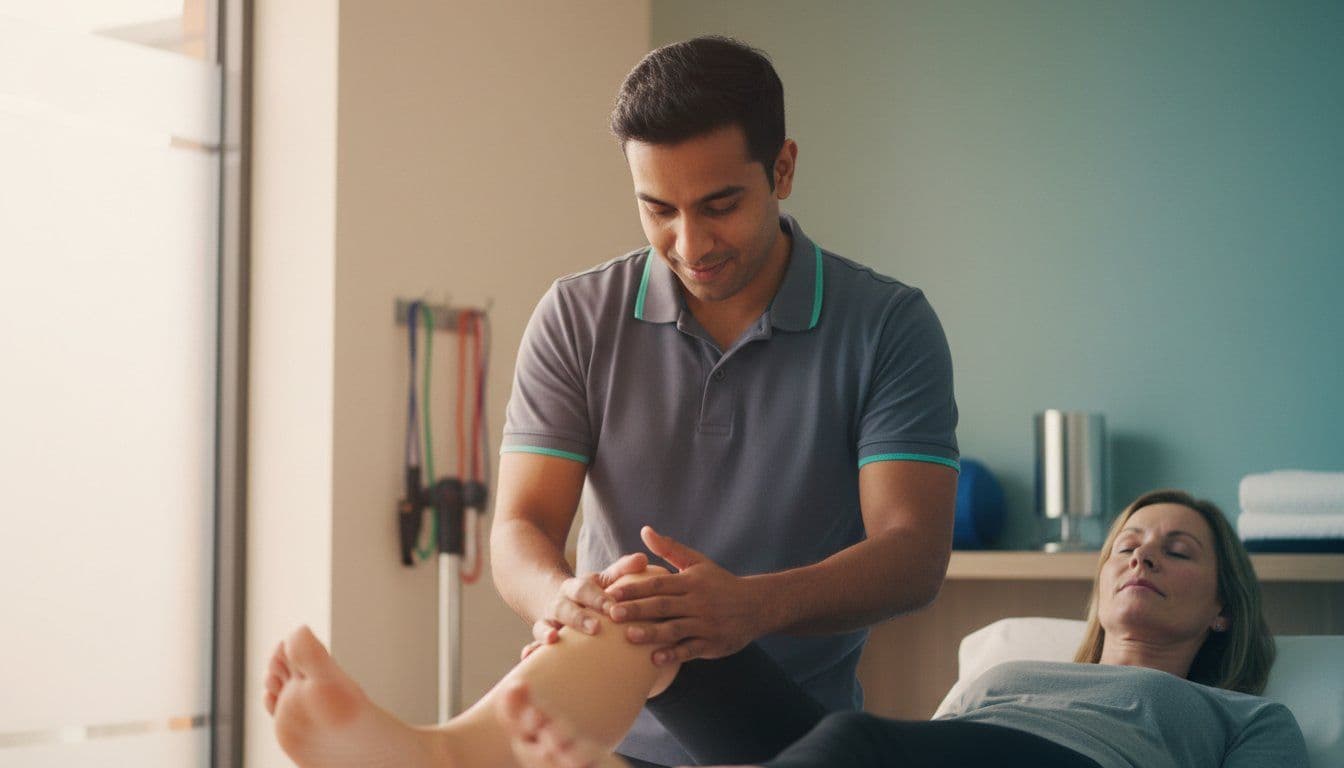
Plantar Fasciitis Relief Milton Keynes: Get Back on Your Feet Without the 18-Month Wait
Tired of heel pain? Get fast plantar fasciitis relief in Milton Keynes with our hands-on approach. Ditch the 18-month wait and get back on your feet.
Imagine swinging your feet out of bed and feeling that sharp, stabbing pain before you've even had a sip of tea. It's a miserable way to start the day, especially when the simple joy of a weekend stroll through Campbell Park feels like a distant memory. If you're searching for plantar fasciitis relief Milton Keynes, you've likely realized that the traditional "wait and see" approach is about as helpful as a chocolate teapot.
I know how frustrating it is to be told to just rest when you're desperate to get moving again. You shouldn't have to settle for long waiting lists or generic exercise sheets that don't seem to make a dent in the discomfort. At our clinic, we take a different path. We believe in hands-on treatment from day one to ensure you're making actual progress rather than just marking time.
In this article, I'll explain why a proactive, manual approach is the key to faster recovery. You'll discover how we identify the root cause of your heel pain and create a clear, jargon-free plan to get you back to running, walking, and enjoying life without the 18-month wait.
Key Takeaways
- Understand why that stabbing first step in the morning happens and what it reveals about the irritation in your foot.
- Learn how tightness in your calves and hamstrings creates a chain reaction that puts extra stress on your heel.
- Discover why sitting on a waiting list isn't a recovery plan and how to secure faster plantar fasciitis relief Milton Keynes through hands-on care.
- Identify the simple home remedies that actually work for acute pain, including the right way to use ice for your feet.
- See how we use advanced tools like shockwave therapy and gait assessments to kickstart your healing and get you back to walking without a limp.
That Stabbing First Step: Seeking Plantar Fasciitis Relief in Milton Keynes
If you've spent your morning hobbling towards the kettle like you're walking on broken glass, you aren't alone. That sharp, localized sting at the base of your heel is more than just a nuisance. It is a sign that the thick band of tissue supporting your arch is struggling. To understand What is Plantar Fasciitis, we look at it as a thickening or irritation of the fascia caused by repetitive strain. It's incredibly common, yet the frustration of having a dodgy foot that refuses to heal for months can feel incredibly isolating.
Finding effective plantar fasciitis relief Milton Keynes shouldn't involve endless waiting. Whether you're a commuter power-walking through the City Centre or a runner training for your next 10k, this pain is your body's way of demanding a change in strategy. We see patients every day who are fed up with wait and see advice. They want to get back to their lives without feeling like every step is a gamble. It is exhausting to live with a condition that makes a simple walk to the car feel like a marathon.
Is it Definitely Plantar Fasciitis?
Not every heel pain is created equal. While the classic sign is a stabbing sensation during those first few steps of the day, there are other culprits like fat pad contusions or nerve entrapment. Usually, plantar fasciitis pain eases off as you move around, only to return after you've been sitting at your desk for an hour. To get a definitive answer, we use a professional gait assessment. This allows us to see exactly how your foot strikes the ground, ensuring we're treating the right problem from the very first session rather than guessing.
Why Milton Keynes Residents Struggle with Heel Pain
Milton Keynes is a city built on hard surfaces. The unforgiving concrete around the Hub and the shopping centre puts immense pressure on your arches, especially if you're wearing unsupportive office shoes or flat pumps. We also see a weekend warrior effect. People who spend all week at a desk then suddenly hammer the paths around Willen Lake or Furzton Lake on a Saturday morning often overload their fascia. It's a recipe for irritation. Combining these repetitive stresses with common footwear mistakes, like wearing worn-out trainers for a commute, is often what tips the balance from a mild ache to chronic pain.
Why Your Heel Hurts: The Mechanics of the Plantar Fascia
Think of your plantar fascia as the ultimate high-tension spring. This thick band of connective tissue isn't just a passive strap; it's a structural masterpiece that acts as your foot's primary shock absorber. Every time your heel hits the ground, the fascia stretches and recoils to manage the load. It's a brilliant system until the demand exceeds what the tissue can handle. When this happens, we aren't just dealing with a bit of swelling. We are looking at structural micro-tears that struggle to repair themselves under constant pressure.
Many people spend weeks taking anti-inflammatories without success because the problem isn't just simple inflammation. It's a mechanical failure. To get genuine plantar fasciitis relief Milton Keynes, we have to identify which part of your movement chain is failing. If we only treat the heel, we're just ignoring the fire and focusing on the smoke. Several factors usually combine to cause this irritation:
- Tight calf muscles pulling on the heel bone.
- Weak glutes causing the foot to roll inward.
- Worn-out footwear that fails to support the arch.
- Sudden changes in activity levels or training surfaces.
The Role of the Achilles Tendon
The Achilles tendon and the plantar fascia are essentially two ends of the same pulley system, meeting at your heel bone. If your calf muscles are chronically tight, they pull the heel bone upwards. This creates a constant, pre-loaded tension on the fascia before you even stand up. Restricted ankle mobility is often the hidden driver here, forcing the foot to overwork with every single step. Simply stretching the sole of your foot might actually be making things worse if you aren't addressing the tension coming from the calf first.
Beyond the Foot: The Hip and Knee Connection
We also have to look much higher up the leg to find the real culprit. If your glutes are weak, your knee might cave inward, causing your foot to over-pronate or flatten excessively. This twisting motion puts an enormous strain on the arch with every stride. It's a perfect example of why foot pain is often the symptom, not the cause. Exploring conservative treatment options that include hip and core stability is often the missing piece of the puzzle.
Understanding your unique biomechanics is the first step toward a pain-free life. If you've been struggling to find plantar fasciitis relief Milton Keynes, a detailed gait assessment can show us exactly how your hips and knees are affecting your feet.
NHS Wait Times vs. Hands-On Relief: Why Wait and See Is Not a Plan
If you've been told that your heel pain will simply "go away" in 18 months, you have every right to feel frustrated. That's a massive amount of time to spend hobbling around Milton Keynes, missing out on your Saturday morning parkrun or even just a comfortable walk to the office. The "wait and see" approach is a passive strategy that often leaves patients in a cycle of chronic pain. We don't believe in just crossing our fingers and hoping for the best. Seeking plantar fasciitis relief Milton Keynes should be about taking active steps toward recovery right now.
Early intervention is about much more than just fixing your foot. When you're in pain, your body naturally changes the way you walk to protect the sore area. This is called compensation. You might find that your opposite knee starts to ache, or your lower back feels stiff because you're offloading your weight. By addressing the issue early with professional plantar fasciitis treatment, we stop these secondary problems before they even start. We want to get you back to your full potential, not just wait for the discomfort to become a permanent fixture in your life.
The Problem with Passive Recovery
Rest is often prescribed as a cure-all, but for the plantar fascia, complete rest can actually be counterproductive. While it might settle the initial irritation, it doesn't do anything to fix the mechanical issues we discussed earlier, like tight calves or weak glutes. As soon as you return to your normal routine, the pain usually flares right back up. There is also a significant risk of developing overuse injuries in your "good" leg because it's doing twice the work. Waiting months for an appointment isn't just annoying; it's physically risky for your long-term mobility.
Hands-On Treatment from Day One
We pride ourselves on being a hands-on clinic. You won't just be handed a photocopied sheet of stretches and sent on your way. From your very first visit, we use manual therapy and sports massage to physically release the tension in your soft tissues. This immediate, physical approach helps to desensitize the area and improve blood flow, which is essential for healing those micro-tears. You can learn more about how we combine these techniques by looking at our services. We believe in doing the hard work with you, ensuring every session feels like a step closer to being pain-free.
Immediate Relief Strategies: What You Can Do Today
While you are waiting for your first session, you need a way to dampen the fire in your foot. You don't have to suffer in silence while you wait for a long-term fix. There are several practical steps you can take at home to manage acute flare-ups and make your daily commute across Milton Keynes a bit more bearable. These strategies aren't meant to replace plantar fasciitis relief Milton Keynes provided by a professional, but they will certainly help you get through the day without wanting to bin your shoes.
One of the simplest ways to manage the ache is by using temporary heel pads or soft orthoses. These aren't a permanent cure, but they act as a "buffer" for your heel bone, taking the immediate pressure off the sensitive fascia. Think of them as a bit of extra suspension for your feet while we work on fixing the underlying mechanical issues. They are particularly useful if you spend all day standing on the hard floors of the city's office blocks.
The Frozen Water Bottle Trick
This is a personal favourite because it provides two treatments at once. Fill a plastic water bottle about three quarters full and pop it in the freezer. Once it's solid, sit in a comfortable chair and roll the bottle under the arch of your foot for about five to ten minutes. The ice helps to numb the area and reduce local irritation, while the rolling action provides a very gentle, controlled massage to the tissue. It is best to do this in the evening after you've been on your feet all day, or first thing in the morning to desensitize the area before you start moving.
Smart Stretching for Your Calves
We've already established that tight calves are a major driver of heel pain. To help, try a simple wall stretch. Stand with your hands against a wall, place one foot back with the heel flat on the floor, and lean forward until you feel a gentle tug in your calf. Hold it for thirty seconds. Consistency is far more important than intensity here. Don't go at it like a bull in a china shop; aggressive stretching during a painful flare-up can actually make the fascia more irritable. Keep it light and frequent.
Choosing the Right Footwear
If you're walking around the Centre:MK in flat ballet pumps or worn-out trainers, your fascia is going to scream. Hard pavements are brutal on your arches. You need shoes with a bit of a "pitch" or heel lift and a firm midsole that doesn't bend in half easily. Also, try to avoid going barefoot at home. A supportive pair of slippers or indoor shoes can prevent that sharp "first step" pain when you get up from the sofa. If you are ready to stop managing the symptoms and start fixing the cause, get in touch with us today to start your recovery plan.
Professional Plantar Fasciitis Treatment at RED Physiotherapy
At RED Physiotherapy, we don't believe in quick fixes that don't stick. While some clinics might push you towards steroid injections or even surgery as a first resort, we focus on a mechanical solution that actually lasts. As a family-run practice, we care about getting you back to your best without dragging out the process or overcomplicating things. We use a clear, three-stage approach. First, we calm the pain down with hands-on treatment. Then, we build your strength back up. Finally, we bulletproof your body for the future. Seeking plantar fasciitis relief Milton Keynes at our clinic means you're getting a plan designed for your specific lifestyle.
We combine our clinical expertise with advanced technology to speed up your recovery. Whether we are using musculoskeletal ultrasound to get a better look at the tissue or applying manual therapy to release tight structures, we are focused on results. We aren't an "exercises-only" clinic. You will receive hands-on care from day one to ensure you feel like you are making actual progress every time you walk through our doors.
Advanced Shockwave Therapy in Milton Keynes
If your heel pain has been hanging around for months, your tissue might have entered a "stalled" healing state. This is where shockwave therapy in Milton Keynes becomes a game changer. It uses acoustic pulses to create a therapeutic micro-trauma, which effectively "reboots" the body's natural repair process. It is a non-invasive way to treat chronic issues that haven't responded to rest alone. We offer this as part of a comprehensive, hands-on plan, ensuring it works in tandem with our manual techniques for the best possible outcome.
Customised Recovery Plans
No two pairs of feet are exactly the same. A runner training for a marathon needs a very different strategy than an office worker who just wants to walk to the train station without a limp. You'll get a clear roadmap from your very first session so you know exactly when you'll be back to full health. You can meet our team to see the experts who will be guiding you through this process. We keep things honest, straight to the point, and focused on providing great value for money.
Fixing the Problem for the Long Term
The final piece of the puzzle is making sure that your plantar fasciitis relief Milton Keynes stays permanent. We don't just want you to feel better for a week; we want you to stay better. This involves looking at your gait and building specific strength to ensure your arches can handle the loads you put on them. Whether it's dry needling to release stubborn knots or a gait assessment to refine your running form, we address the root cause. Stop settling for the 18-month wait and start your journey back to full health. Book your assessment today and let's get you back on your feet.
Take the First Step Toward Pain-Free Movement
You don't have to spend another year hobbling out of bed or avoiding the beautiful paths around Milton Keynes. We've explored how that stabbing heel pain is often a symptom of wider mechanical issues, and why simply waiting for it to disappear naturally rarely works. Real progress comes from a proactive approach that combines an expert understanding of your movement with the right tools to kickstart your recovery.
Finding lasting plantar fasciitis relief Milton Keynes is much easier when you have a clear plan and a team that actually provides hands-on care from day one. We offer advanced shockwave therapy and customized recovery strategies to ensure you aren't just managing the pain, but fixing the cause. With our expert local team and no long waiting lists, you can start your journey back to full health immediately. We are a family-run practice that prioritizes results and honest, effective treatment.
Stop letting foot pain dictate your weekend plans. Whether you want to return to competitive running or just enjoy a comfortable walk to the office, we have the expertise to get you there. Book Your Hands-On Assessment in Milton Keynes Today and let's get you moving properly again. You've got this, and we're ready when you are.
Frequently Asked Questions
How do I know if I have plantar fasciitis or something else?
If you're feeling a sharp, localised sting at the base of your heel, you've likely joined the club. It's usually most aggressive during those first few steps in the morning or after you've been stuck in a long meeting. Other conditions like fat pad contusions feel more like a dull, bruised ache across the whole heel. We use a professional assessment to ensure you're getting the right plantar fasciitis relief Milton Keynes rather than just guessing.
Will my heel pain ever go away without surgery?
Absolutely. In fact, we rarely see cases that actually require a surgeon's intervention. Most heel pain responds brilliantly to a combination of hands-on manual therapy, targeted strengthening, and occasionally shockwave therapy. The goal is to fix the mechanical failure that caused the irritation in the first place. Surgery is a drastic step that most of our patients successfully avoid by following a clear, structured recovery plan.
Can I continue running with plantar fasciitis?
You don't have to hang up your trainers entirely, but you might need to be a bit sensible with your mileage. We often suggest load management where we keep you moving at a level that doesn't make the pain flare up the next morning. Using a gait assessment helps us identify if your running style is aggravating the fascia. It's much better to keep the engine ticking over than to stop completely and let everything get even stiffer.
Why is the pain always worse in the morning?
While you're asleep, your foot naturally relaxes and the fascia tightens up. When you swing your legs out of bed and stand up, you're suddenly forcing that cold, stiff tissue to stretch under your full body weight. It's a bit like pulling a cold rubber band too quickly. Once you've hobbled around for a few minutes and got the blood flowing, the tissue becomes more pliable and the pain usually settles down to a dull ache.
How long does physiotherapy take to work for heel pain?
Most people notice a clear difference within 3 to 6 sessions of hands-on treatment. While the underlying tissue can take a few months to fully remodel and strengthen, the sharp, daily pain usually starts to retreat much sooner. We focus on getting you back to your daily routine in Milton Keynes without that constant worry. Every foot is different, but having a clear roadmap means you'll see progress every single week.
Is shockwave therapy painful?
It's a bit of a strange sensation, often described as a fast, rhythmic tapping on the skin. While it can be a little uncomfortable, especially on a sensitive heel, it shouldn't be unbearable. We can always adjust the intensity to make sure you're comfortable. Most patients find the brief discomfort is a small price to pay for the accelerated healing it provides. Each session only lasts about five to ten minutes per foot.
Does the NHS provide effective treatment for plantar fasciitis?
The NHS provides standard care, but the real issue is the time it takes to get seen. When you're in pain today, being told there's an 18-month wait for plantar fasciitis relief Milton Keynes is incredibly demoralising. Passive advice often leads to chronic issues and compensatory pains in your knees or back. Private care allows us to get stuck in immediately with hands-on treatment and advanced tools like ultrasound.
What are the best stretches for immediate relief?
Focus on your calves and your big toe. A tight calf muscle is often the main culprit pulling on your heel bone. Try a gentle wall stretch or use a step to let your heels drop slightly. You can also gently pull your big toe back toward your shin to stretch the arch itself. Just remember to keep it gentle. Aggressive stretching during a flare-up might end up annoying the fascia even more.
When to Seek Help
While most heel pain is manageable, there are a few red flags that mean you should see us sooner. If you have constant pins and needles, numbness in your foot, or pain that keeps you awake at night, it's time for a professional look. You should also seek help if your foot is swollen, hot to the touch, or if you simply cannot put any weight on it at all. These can be signs of other issues that need immediate clinical attention.
Focus Keywords
plantar fasciitis relief Milton Keynes
Tags:
About the Author
Red Physiotherapy Team
Content Team
Health and wellness content from the RED Physiotherapy team.