
Preparing for Ski Season: Why You Need a Physio MOT in Milton Keynes
Hitting the slopes? For preparing for ski season, physio in Milton Keynes is key. Our hands-on MOT finds and fixes weak spots to prevent holiday-ending pain.
You've booked the flights, picked out the perfect chalet, and you're already dreaming of that first après-ski drink. But then day three hits. Your knees feel like they're made of glass, your lower back is screaming, and that old injury you ignored all summer is suddenly making every turn a misery. If you're currently preparing for ski season physio Milton Keynes is the best place to start ensuring your body is actually up to the task. Most people assume a few rushed squats in the gym will get them mountain-ready, but skiing is a high-impact sport that demands far more than just basic leg strength.
We know how frustrating it is to have a hard-earned holiday cut short by physical limitations. It's why we believe a professional pre-ski MOT is essential for anyone heading to the slopes this year. In this guide, you'll discover how hands-on physiotherapy can identify your physical bottlenecks and fix them before they become a holiday-ending problem. We will show you how to build a plan that gives you the confidence to handle six full days of movement, moving beyond generic gym advice to get real, lasting results that keep you on the snow.
Key Takeaways
- Understand why targeting ski-specific muscle groups 6 to 8 weeks in advance is crucial for surviving your first day on the slopes.
- Learn how to avoid the common "Day 3 Wall" where fatigue-related injuries are most likely to ruin your holiday.
- Discover why preparing for ski season physio Milton Keynes involves more than just squats, focusing on hands-on manual therapy to fix joint stiffness first.
- Get practical advice on building the specific eccentric strength and balance needed to handle unpredictable alpine terrain.
- Identify the physical "red flags" that require a professional MOT to ensure you aren't carrying a ticking time bomb to the mountains.
Why Pre-Ski Prep is More Than Just Buying New Salopettes
Most people spend weeks browsing the latest gear, but they spend exactly zero minutes checking if their knees can actually handle a black run. If you're currently preparing for ski season physio Milton Keynes is often the missing piece of the puzzle. While your new salopettes might look the part, they won't stop your quads from burning out by lunchtime on Monday. Skiing demands a very specific type of fitness that your average commute or standard gym session simply doesn't touch.
The transition from a desk in Milton Keynes to the mountains is a massive shock to the system. You spend most of your week in a seated position, which leaves your glutes switched off and your hip flexors tight. Suddenly, you're asking those same muscles to perform complex lateral movements and maintain deep isometric holds for hours. This is where 'gym fit' usually fails. You might be able to smash out a heavy set of squats, but can you control your descent while your muscles are screaming? That's the difference between being strong and being ski-ready.
The problem is that the basics of alpine skiing require a level of eccentric control that most gym routines ignore. When you're carving down a slope, your muscles aren't just shortening to create movement; they're lengthening under tension to act as brakes. This 'braking' force is what saves your joints. If your quads aren't trained for this, they'll give up, and that stress goes straight into your ACL or your lower back.
The Unique Demands of Winter Sports
Skiing is a strange mix of static endurance and sudden bursts of power. You're holding a tuck position one second and reacting to a hidden mogul the next. Altitude also plays a huge role. Your heart has to work harder to pump oxygen to your muscles, which means you'll tire much faster than you do at sea level. Cold temperatures don't help either, as they can cause joint stiffness and reduced circulation. A proper MOT identifies these physical bottlenecks early, ensuring your body can recover as fast as you can ski.
When to Start Your Training
Six to eight weeks is the 'sweet spot' for your body to actually change. This timeline allows us to use hands-on treatment to clear up any existing aches before we move on to building ski-specific power. We look at everything from your ankle mobility to your core stability. Ski conditioning is a blend of strength, proprioception, and mobility. By starting now, you avoid the 'Day 3 Wall', that dreaded moment on Wednesday afternoon when your legs turn to jelly and your risk of injury skyrockets. Don't let your holiday be defined by how much Ibuprofen you can take. Get your body ready properly.
The Day 3 Wall and Common Ski Injuries We See in Milton Keynes
Most skiers start their holiday with a burst of adrenaline. Monday and Tuesday are usually great, but then Wednesday afternoon arrives. This is what we call the 'Day 3 Wall'. By this point, your muscles are physically exhausted, your technique starts to get sloppy, and your reaction times slow down. It is no coincidence that this is when the majority of accidents happen. When you are preparing for ski season physio Milton Keynes specialists often focus on building the specific endurance needed to push through this fatigue safely.
Living in Milton Keynes, we are lucky to have the Snozone right on our doorstep. It is a fantastic resource for refreshing your technique, but it has its limits. A few hours on a controlled, indoor slope doesn't replicate the sheer volume of movement you'll face on a mountain. The 'Snozone effect' can give you a false sense of security. While your skills might be sharp, your body still needs to be prepared for the six hours of daily activity and the unpredictable terrain found in the Alps.
We also find that existing 'niggles' from daily life get magnified in the mountains. That slight shoulder ache from your mouse or the stiff back from your commute becomes a genuine problem when you're lugging 10kg of boots and skis across a frozen car park. If your body isn't moving correctly, these small issues quickly turn into holiday-ending pain.
Knee Injuries: The Skier’s Achilles Heel
Knee injuries are the most frequent problem we treat in our Milton Keynes and Northampton clinics. Catching an edge can cause a sudden, violent twist that leads to MCL or ACL strains. A major risk factor is 'Dynamic Valgus', which is a clinical term for the knee collapsing inwards during movement. This usually happens because your glutes are too weak to keep your leg stable. Strong glutes act as a primary protector for your knee joints, and without them, you are far more likely to suffer one of the common ski injuries that keep people off the slopes for months.
Lower Back Pain and the "Skier’s Stance"
The forward-leaning 'skier’s stance' is great for control, but it puts an enormous amount of pressure on your lumbar spine. If your core isn't strong enough to support this position, you'll end up with significant lower back strain. This is often made worse by the physical demand of carrying heavy equipment. Sometimes, the pain you feel in your back is actually referred pain from stiff hips or poor ankle mobility. If you are worried about an old injury flaring up, it might be time to check out our physiotherapy services to ensure you're in top shape before you fly.
Hands-On Treatment: Why We Are Not Just an Exercises-Only Clinic
Many clinics will hand you a generic printout of leg exercises and send you on your way. At RED, we think that's a bit like trying to tune a high-performance engine without checking if the wheels are stuck. If you are preparing for ski season physio Milton Keynes should be about more than just a gym program. Our philosophy is simple: we fix the physical restrictions first, then we build the strength. You can't squat your way out of a stiff ankle joint, and no amount of lunges will help if your hip isn't rotating properly.
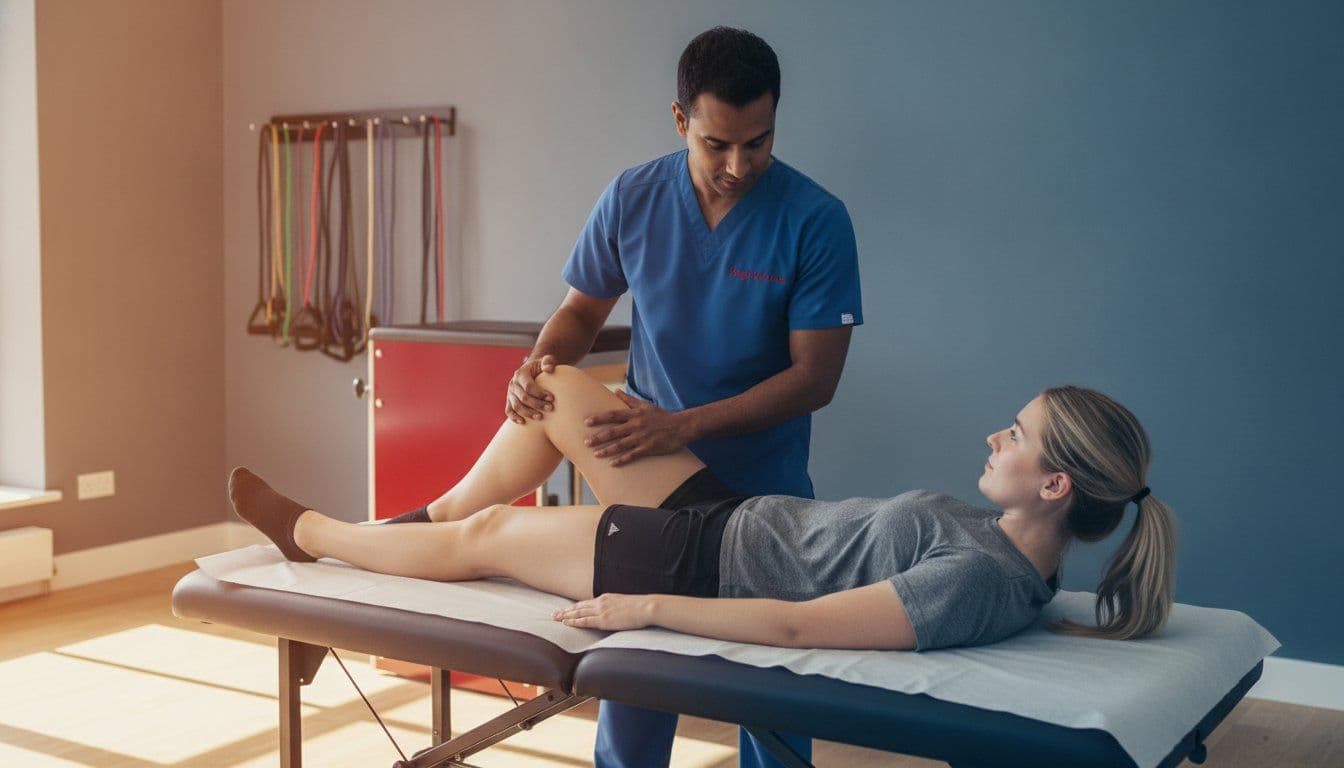
We use hands-on treatment from day one to 'unlock' your body. This ensures that when you do start your training, you're actually moving through a full, safe range of motion. It's about efficiency. We don't want to drag out your treatment; we want to get your body mountain-ready as quickly as possible. This proactive approach is a vital part of your off-season strength and conditioning, ensuring you aren't just strong, but functional. If your joints are restricted, your body will find a way to move around the problem, which usually leads to a flare-up of an old injury just as you hit the snow.
The RED Pre-Ski Assessment
When you come in for your MOT, we don't just look at muscle size. We perform a detailed 1-on-1 screening to see how your body actually moves. We test the range of motion in your ankles, which is essential for that deep forward lean in your boots, as well as your hips and thoracic spine. If your mid-back is stiff, your lower back will overcompensate, leading to that screaming ache by Tuesday afternoon. We focus on movement patterns, identifying the subtle imbalances that could lead to a 'catch' or a twist on the slopes.
Manual Therapy and Recovery
Our toolkit includes far more than just advice. We use joint mobilisations to restore movement and dry needling to release stubborn muscle knots that might be limiting your power. A key part of our pre-season strategy is sports massage, which helps address soft tissue restrictions and flushes out the tension from your training sessions. By clearing these physical roadblocks early, we ensure your muscles are primed and ready for the explosive power skiing requires. We are here to get you results, not just a list of homework.
Practical Steps for Peak Performance: Strength, Balance, and Control
Once we've used hands-on treatment to clear your joint restrictions, it's time to build the specific engine you need for the snow. When preparing for ski season physio Milton Keynes based training often misses a vital component: eccentric strength. Most people focus on the 'push' of a squat, but skiing is largely about the 'brake'. Your muscles need to be able to lengthen under tension to absorb the force of every turn and bump. Without this braking power, your joints take the hit instead of your muscles.
Building this control doesn't require a mountain of equipment. You can start right in your living room in Milton Keynes or Northampton. The goal is to move beyond basic gym routines and focus on unilateral stability and rotational power. If you can't control your body weight on one leg on flat ground, you certainly won't be able to do it on a 30 degree icy slope.
The "Big Three" Exercises for Skiers
- Bulgarian Split Squats: This is the gold standard for unilateral leg power. Place one foot behind you on a chair and squat deeply on the lead leg. Focus on a slow, three second descent. This builds the quad endurance and hip stability needed for long downhill runs.
- Lateral Bounds: Skiing is a side to side sport. Practise jumping laterally from one foot to the other, focusing on landing softly and 'sticking' the position. This mimics the explosive side to side control required for carving.
- The Plank with a Twist: Core stability isn't just about doing sit ups. A skier needs to resist rotation while their legs move independently. Adding a slow hip twist to your plank forces your obliques to work, protecting your spine during those sharp turns.
Balance and Proprioception
Skiing is essentially a long series of balance recoveries. If your brain can't tell exactly where your ankles are in space, you're going to have a hard time when the visibility drops. We use single leg stands and 'clock reach' drills to sharpen this connection. This proprioception is your first line of defence against a nasty fall. If your balance feels off, a professional gait assessment can reveal exactly where your movement patterns are failing. It's about fixing the foundation before you add the speed.
Ready to ensure your body can handle the heat of the slopes? Book your pre-ski MOT today and let's build a plan that keeps you skiing from the first lift to the last run.
When to Seek Help and Getting Your Pre-Ski MOT at RED Physiotherapy
It is easy to ignore a small ache when you are busy packing your bags and checking the snow reports. However, when you're preparing for ski season physio Milton Keynes based experts can tell you that a minor niggle on the pavement often becomes a major problem on a red run. You don't want to find out your knee isn't up to the task when you are halfway down a mountain in the Three Valleys. Taking a proactive approach now means you can focus on your technique and the views, rather than wondering if your back will last until lunch.
A professional MOT isn't just for people who are already in pain. It is for anyone who wants to ensure their body is moving efficiently. By seeing a physiotherapist near me before you fly, you get a clear picture of your physical readiness. We identify the stiff joints or weak muscle groups that could lead to trouble, providing hands-on treatment to clear those issues before they flare up under the pressure of six days of intensive movement.
When to Seek Help
There are certain 'red flags' that you should never ignore before a ski trip. If you experience sharp pain, swelling, or a sensation of the knee 'giving way' during normal activity, your joint is sending you a clear warning. Persistent back pain that limits your ability to bend or twist is another sign that your core isn't providing the support you need. Even if you just feel 'unsteady' or unsure if your current fitness level is safe for the slopes, a professional assessment provides the clarity you need. We see these issues every day in our Milton Keynes, Northampton, and Towcester clinics, and we know exactly how to fix them fast.
Book Your Pre-Ski MOT Today
At RED Physiotherapy, we are a family-run practice that genuinely cares about getting you back to the activities you love. We aren't here to give you a list of exercises and send you home. We provide hands-on, effective treatment from your very first visit. Our goal is to fix the underlying problem efficiently, giving you a tailored plan that fits your specific goals and timeline. Don't leave your holiday to chance. Contact us today to book your session and step onto that first lift with total confidence in your body.
Your Pre-Ski Checklist:
- Book a 1-on-1 assessment to check ankle and hip mobility.
- Address any existing 'niggles' with hands-on manual therapy.
- Begin your eccentric leg strength and balance drills at least 6 weeks out.
- Ensure your core can handle the rotational demands of carving.
- Pack your gear, knowing your body is mountain-ready.
Focus Keywords: preparing for ski season physio Milton Keynes, physiotherapist near me, physiotherapy Milton Keynes, sports massage Milton Keynes.
Ready to Own the Mountain?
Don't let your hard-earned holiday become a week of nursing a swollen knee or a stiff back. We've seen how a professional MOT identifies the physical bottlenecks that generic gym squats simply won't reach. By focusing on eccentric strength and joint mobility now, you're not just preventing injury. You're ensuring you have the endurance to enjoy every single run from the first lift to the final après-ski. When you're preparing for ski season physio Milton Keynes is your best ally to ensure your body is actually mountain-ready.
Our expert team across Milton Keynes, Northampton, and Towcester provides hands-on treatment from day one to get you evidence-based results. We don't believe in dragging out treatment; we believe in getting you fit for the activities you love. Take the uncertainty out of your trip and ensure your body can handle whatever the Alps throw at you. Book Your Pre-Ski MOT at RED Physiotherapy Today and step onto the snow with total confidence.
Frequently Asked Questions
How long before my ski trip should I start physiotherapy?
You should ideally start your preparation 6 to 8 weeks before you head to the mountains. This timeframe allows for genuine physiological adaptation in your muscles and gives us the opportunity to use hands-on treatment to clear any joint stiffness. By starting early, you ensure that your strength training is built on a functional foundation, making your time on the snow much safer.
Can a sports massage help me prepare for skiing?
Yes, sports massage is a vital part of pre-season conditioning. It helps to manage soft tissue tension and improves circulation, ensuring your muscles stay supple for explosive movements. We often use it to help patients recover from their training drills, making sure they don't head to the airport with existing muscle fatigue or tight spots that could flare up on the slopes.
What is the most common ski injury treated by physios in Milton Keynes?
Knee ligament strains are the most frequent issue we see. When you are preparing for ski season physio Milton Keynes based specialists focus on glute strength and knee alignment to prevent these twists. By identifying movement errors early, we can protect your ACL and MCL from the common forces that cause holiday-ending injuries, ensuring your joints are supported by strong, responsive muscles.
Is it too late to start preparing if my holiday is in two weeks?
It is never too late for a professional MOT. Even if you fly in two weeks, hands-on mobilisations can clear joint restrictions that might lead to pain. While we can't build massive strength in a fortnight, we can certainly 'unlock' your body and give you the specific advice needed to navigate your first few days safely without an old injury holding you back.
Do I need a referral to see a physio for a pre-ski check-up?
You do not need a GP referral to see us. As a private, family-run clinic, we offer direct access to all our services, from dry needling to gait assessments. This allows you to bypass the frustration of NHS wait times and get the fast, effective results you need to enjoy your holiday with total peace of mind and physical confidence.
How can I prevent knee pain while skiing?
Preventing knee pain requires a mix of eccentric quad strength and solid hip control. Your muscles need to act as the primary shock absorbers for the terrain. We also look at your ankle mobility, because if your ankles are stuck in your boots, your knees often have to overcompensate, leading to that familiar afternoon ache that ruins the final runs of the day.
What should I do if I hurt my knee on the slopes?
Follow the PEACE and LOVE protocol immediately to manage swelling and protection. If you have sharp pain or the joint feels unstable, seek local medical advice at the resort. Once you return to the UK, come and see us for a full assessment and a hands-on plan to ensure you return to full strength quickly and efficiently without dragging out the recovery process.
Are there specific exercises for snowboarders vs skiers?
Snowboarders generally require more rotational core stability and ankle proprioception. Because your feet are locked onto a single board, your hips and midsection do a lot more work to initiate turns. When preparing for ski season physio Milton Keynes assessments for boarders focus on your ability to resist and create twist safely, protecting your spine and knees from the unique stresses of boarding.
Focus Keywords: preparing for ski season physio Milton Keynes, physiotherapist near me, physiotherapy Milton Keynes, sports massage Milton Keynes.
Tags:
About the Author
Red Physiotherapy Team
Content Team
Health and wellness content from the RED Physiotherapy team.