
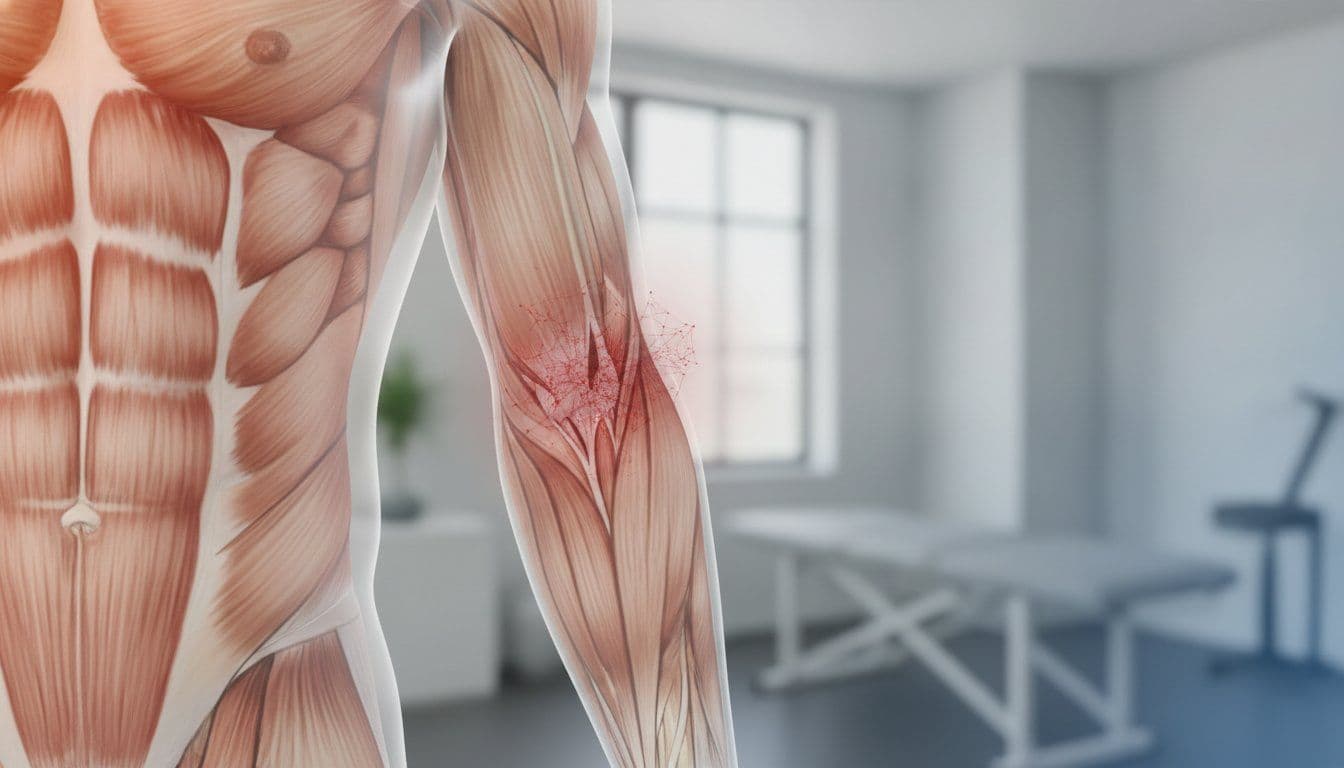
Physiotherapy for Tennis Elbow: Get Back to Your Best in Milton Keynes & Northampton
Get effective physiotherapy for tennis elbow in Milton Keynes & Northampton. Our hands-on treatment fixes the root cause, so you can ditch the pain for good.
Resting your arm and hoping for the best is often the worst thing you can do for a tendon injury. While it sounds sensible to stop moving when your elbow flares up, complete rest often leads to weakness and a stubborn cycle of pain that never quite clears. If you're struggling to grip a coffee mug or find yourself wincing every time you click a mouse, you've likely realised that the standard wait and see method isn't a strategy. You need a proactive plan. Choosing physiotherapy for tennis elbow is about more than just managing symptoms. It's about rebuilding the strength your tendon needs to handle daily life again.
We understand how frustrating it is to be stuck on a long NHS waiting list while your golf swing or your work productivity suffers. At our family run clinics in Milton Keynes, Northampton, and Towcester, we don't believe in the exercise only approach that leaves you feeling like a number. You deserve hands on treatment from your very first session to kickstart your recovery. In this guide, we'll show you how our expert clinicians use advanced techniques like shockwave therapy and targeted loading to get you back to your best. We'll move past the generic advice and focus on a clear, results driven path to permanent relief.
Key Takeaways
- Stop waiting for the pain to disappear. Learn why complete rest is a myth and how "loading" the tendon is the secret to real recovery.
- Understand why hands-on physiotherapy for tennis elbow is more effective than a generic exercise sheet you will probably never use.
- See how our family-run clinics in Milton Keynes, Northampton, and Towcester help you skip the frustration of long waiting lists with a plan tailored to your lifestyle.
- Identify the everyday triggers, from your office mouse to your morning kettle, and learn the simple tweaks to protect your arm while it heals.
What is Tennis Elbow and Why is Your Arm Aching?
If you have spent any time Googling your symptoms, you have likely come across the technical name: lateral epicondylitis. In simple terms, What is tennis elbow is essentially an overuse injury of the common extensor tendon. This is the bit of tough tissue that connects your forearm muscles to the bony bump on the outside of your elbow. When this tendon becomes irritated, even the smallest movements can feel like a massive chore.
Think of your tendon like a battery. It has a specific amount of capacity to handle the work you throw at it. When you ask that tendon to do more than it is capable of, whether that is clicking a mouse for eight hours or painting a ceiling, it starts to protest. It is a capacity problem, not a sign that your arm is permanently broken. Effective physiotherapy for tennis elbow focuses on increasing this capacity so you can get back to your daily routine without that nagging ache.
You do not need to be a pro athlete at Wimbledon to suffer from this. Most of the patients we see at RED Physiotherapy are not even holding a racket. They are just trying to get through the day without a sharp pain shooting up their arm when they lift a kettle or turn a door handle. Because it is an overuse injury, it often creeps up slowly until one day you realise you can't even grip your morning coffee mug properly.
Common Symptoms You Might Be Ignoring
It is easy to dismiss a bit of stiffness in the morning, but tennis elbow has a way of making itself known during the most mundane tasks. You should look out for these specific signs:
- Point tenderness directly on the bony bit on the outside of your elbow.
- A noticeable drop in grip strength, making it harder to open jars or shake hands confidently.
- A dull, nagging ache that travels down your forearm toward your wrist, often feeling worse after a long day at work.
Who is Most at Risk in Milton Keynes and Northampton?
We treat a huge variety of people across our family run clinics in Milton Keynes, Northampton, and Towcester. While the causes vary, the underlying issue is usually repetitive strain that the body hasn't had time to recover from. We see three main groups of people struggling with this:
- Office workers. Those spending long hours at a desk in Milton Keynes often develop symptoms due to poor workstation setups and repetitive mouse clicking.
- Manual tradespeople. Plumbers, electricians, and decorators across Northamptonshire frequently overload their tendons through repetitive manual work and heavy lifting.
- Active locals. Whether you are hitting the gym in Towcester or joining a local sports club, a sudden spike in training volume can trigger a flare up.
If any of this sounds familiar, it is time to look at how we can fix the root cause rather than just masking the pain. You can find more about our physiotherapy services and how we tackle these specific injuries using a hands on approach from your very first visit. We specialise in physiotherapy for tennis elbow to help you regain your strength and get back to doing what you love.
The Myth of Just Rest: Why Your Elbow Pain is Not Improving
"Just rest it" is probably the most frequent advice you will hear from well-meaning friends or generic health websites. It sounds logical. If it hurts to move, stop moving. However, for a tendon, total rest is often the worst thing you can do. When you stop using your arm completely, you enter the "rest-pain-repeat" cycle. The pain might settle while you are sitting on the sofa, but as soon as you pick up a kettle or return to your desk, the ache returns with a vengeance. This happens because the tendon hasn't actually healed; it has just become even less capable of handling any weight.
Tendons rely on a process called mechanotransduction. This is a fancy way of saying that tendon cells need to be "pulled" and "loaded" to stimulate repair. Without the right kind of movement, the tendon stays in a weakened, sensitive state. Generic advice to "take a few weeks off" fails to address the root cause of why your arm gave out in the first place. You need a specific plan to rebuild that capacity, which is where specialized physiotherapy for tennis elbow becomes essential. Our goal is to find the "sweet spot" of activity that encourages healing without causing a flare-up.
Why Tendons are Different from Muscles
Tendons are not like muscles. Muscles have a rich blood supply and can bounce back relatively quickly after a strain. Tendons, on the other hand, have a much poorer blood supply. This means they heal significantly slower and require very specific stimulus to change. If you opt for total rest, you risk "disuse atrophy," where the surrounding muscles and the tendon itself become even more vulnerable. It is a structural change in the tendon tissue rather than just simple inflammation that can be iced away. This is why physiotherapy for tennis elbow focuses on structural remodeling rather than just "calming things down."
The Problem with NHS Wait Times
We see many patients in our Milton Keynes and Northampton clinics who have spent months waiting for an NHS referral. By the time you get to see someone, that minor niggle has often turned into a proper chronic issue. Chronic tennis elbow involves more complex changes in the nervous system and the tendon structure, making it much harder to treat than an acute flare-up. Seeking early intervention from a private physio in Towcester or Northampton saves you time and money in the long run by stopping the problem before it settles in for good. You can check out various Tennis elbow treatment options to see the range of approaches available, but nothing beats a hands-on assessment. If you are tired of waiting for a generic exercise sheet, take a look at our transparent pricing to get started with a real plan right away.
Hands-On Physiotherapy vs. The Exercise-Only Approach
We have all been there. You wait weeks for an appointment, only to be handed a photocopied sheet of wrist curls and told to come back in a month. It is frustrating, and frankly, it is not enough to fix a stubborn injury. At RED Physiotherapy, we take a different stance. While specific exercises are crucial for long-term strength, they are much harder to perform when your elbow is screaming in pain. Our approach to physiotherapy for tennis elbow is built on the belief that you need hands-on intervention to break the pain cycle first.
We don't just guess what is happening inside your arm. Our clinics utilize musculoskeletal ultrasound to "look under the hood" and see the actual state of your tendon. This allows us to move beyond generic advice and create a plan based on your specific clinical picture. By using manual therapy to desensitise the area, we can lower your pain levels quickly, which then makes your rehabilitation exercises much more effective. It is about working smarter, not just harder.
Our Clinical Toolkit for Tennis Elbow
Fixing a tendon that has failed to heal requires more than just one tool. We use a combination of evidence-based techniques to get you moving again without the constant wince:
- Manual Therapy: Deep tissue massage and joint mobilisations help to improve local blood flow and reduce the stiffness that often builds up around the elbow joint.
- Dry Needling: This is a highly effective way to release tension in the forearm muscles. By targeting specific trigger points, we can reduce the constant "tugging" sensation on your injured tendon.
- Shockwave Therapy: For chronic cases that haven't responded to traditional methods, this is a game-changer. It uses acoustic waves to stimulate a fresh healing response in the tissue. You can find out more in our Shockwave Therapy guide.
Why We Start Treatment on Day One
There is no "waiting and seeing" at our clinics. From your very first session in Milton Keynes, Northampton, or Towcester, we get stuck in. We don't believe in making you wait for relief. By combining expert hands-on work with a tailored loading programme, we help you reach your goals faster. Whether you want to get back to your weekend golf at Collingtree Park or you just want to prune the roses in your garden without pain, our family-run practice focuses on what matters to you. If you are ready for a clear plan that delivers real-world results, take a look at our physiotherapy services to see how we can help you get back to your best.

Practical Advice: Managing Tennis Elbow at Home and Work
While we handle the hands-on clinical work, your daily habits determine how quickly you progress between sessions. A simple way to check your current status is the "kettle test." Try lifting a full kettle with a straight arm and your palm facing downwards. If this causes a sharp wince, your tendon capacity is currently low. As you move through your course of physiotherapy for tennis elbow, this test becomes a rewarding way to track your real-world progress and increasing strength.
We often see patients in Northampton and Towcester relying on "epicondylitis clasps" or compression braces. These are useful for getting through a heavy DIY session or a long day at the computer, but they are essentially a temporary crutch. They don't fix the underlying weakness. For a long-term solution, you need to modify how you work and rebuild the tissue from the inside out. You can explore various Tennis elbow treatment options, but these lifestyle tweaks are the foundation of staying pain-free.
Ergonomic Fixes for the Office
For the desk-bound workers in Milton Keynes, your workstation is often the primary culprit behind that nagging ache. If your wrist is constantly angled upwards while using a mouse, you are keeping the elbow tendons under constant, irritating tension. Aim for a neutral, straight wrist position. A vertical mouse is a fantastic investment here because it places your forearm in a natural "handshake" position. We also suggest taking micro-breaks every 30 minutes. Just a few seconds of movement prevents the "static loading" that tendons find so frustrating.
Simple Exercises to Start Today
Movement should be productive, not punishing. The "no pain, no gain" approach is a total disaster for tendons. Start with isometric holds. Hold a light weight perfectly still with your wrist straight for 30 to 45 seconds. This helps to settle the pain signals and builds initial tolerance. Once that feels easy, progress to eccentric lowering. This involves using your healthy hand to lift a weight and then slowly, controlledly lowering it with the affected arm. This technique is the gold standard for remodelling the tendon structure and building lasting resilience.
Avoid the urge to aggressively stretch the forearm if it feels tight. Pulling on an irritable tendon often makes the pain sharper and stalls your recovery for weeks. If you are unsure about your current technique or want a professional eyes-on assessment, book a session with our experts to get a tailored, safe roadmap. We provide the hands-on care and professional guidance you need to stop the guesswork and get back to your best.
Fixing Tennis Elbow in Milton Keynes, Northampton, and Towcester
At RED Physiotherapy, we don't believe in the "one size fits all" approach that often leaves patients feeling frustrated and unheard. We are a family-run business, and we take pride in treating our local community across Milton Keynes, Northampton, and Towcester with genuine care. Our philosophy is simple. We provide hands-on treatment from day one to help you find rapid relief, rather than just handing you a generic sheet of exercises and sending you on your way. We know you want results, not a homework assignment.
Whether you are an office worker struggling with a mouse or an athlete aiming to return to the court, we focus on what matters to you. By combining expert manual therapy with advanced tools like shockwave therapy, we tackle the root cause of your discomfort. We don't want to see you for months on end. We want to fix the problem efficiently so you can get back to your normal life without the constant shadow of elbow pain. Choosing specialized physiotherapy for tennis elbow means choosing a clear, honest, and professional path to recovery.
When to Seek Professional Help
It is easy to hope that a bit more rest will finally do the trick, but tendons can be incredibly stubborn. You should consider booking an assessment if you notice any of the following signs:
- The pain is persistent enough to wake you up at night or is actively preventing you from performing your job duties.
- You have tried resting the arm and doing basic stretches for more than two weeks with no noticeable improvement.
- The pain is no longer confined to your elbow and is starting to radiate into your shoulder or neck. In some cases, what feels like elbow pain can actually be related to other issues, which we discuss in our Trapped Nerve blog.
Take the First Step Toward Recovery
You don't have to navigate this recovery alone. We have clinics conveniently located in Milton Keynes, Northampton, and Towcester, making it easy to find expert care close to home. During your initial assessment, we will provide a clear and honest plan of action so you know exactly what to expect. We believe in being open about every aspect of your care, which is why you can check our transparent pricing online before you even book. If you are ready to stop "waiting it out" and start moving forward, we are here to help. Expert physiotherapy for tennis elbow is about more than just pain relief; it is about giving you the confidence to use your arm fully again.
Ready to Regain Your Grip and Ditch the Ache?
You don't have to settle for a weak grip or a nagging pain that ruins your morning coffee. As we have discussed, total rest is rarely the answer for a struggling tendon, and a generic sheet of exercises isn't much better. Real recovery happens when you combine expert hands-on treatment with a plan that actually prepares your arm for the demands of your daily life. Whether you are clicking a mouse in Milton Keynes or lifting weights in Northampton, your recovery deserves a personalized touch.
Choosing specialized physiotherapy for tennis elbow at our family-run clinics means you get expert clinical eyes on your injury from day one. We don't just "wait and see." We get stuck in with manual therapy and advanced tools to desensitise the area and get you moving again. You deserve a clear, honest roadmap that leads to lasting results rather than temporary fixes.
If you are tired of the rest-pain-repeat cycle, take the first step today. Book Your Hands-On Assessment in Milton Keynes, Northampton, or Towcester and let's get you back to your best. We look forward to helping you reach your full physical potential and getting you back to the activities you love.
Frequently Asked Questions
Is physiotherapy effective for tennis elbow?
Yes, it is highly effective when it focuses on progressive loading rather than just rest. Research shows that structured physiotherapy for tennis elbow leads to better long-term outcomes than wait and see methods. We use hands-on techniques like manual therapy and dry needling to reduce pain, followed by specific exercises to strengthen the tendon. This dual approach ensures you don't just get temporary relief but build a resilient arm that can handle daily tasks again.
How many sessions of physio will I need for tennis elbow?
Most patients see a significant improvement within 4 to 6 sessions, though every injury is unique. Our goal at RED Physiotherapy is to get you back to your best as efficiently as possible without dragging out your treatment. We provide a clear plan from your first visit in Northampton or Milton Keynes. Factors like how long you have had the pain and your activity levels will influence the total number of sessions required for full recovery.
Can I still go to the gym with tennis elbow?
You absolutely can, but you will likely need to modify your routine. We don't believe in stopping all activity, as this leads to weakness. Instead, we help you adapt your lifting technique or swap certain exercises to reduce the tug on your elbow tendon. Keeping the rest of your body strong is vital while we focus on targeted physiotherapy for tennis elbow to fix the local issue and restore your full strength.
Will I need a steroid injection for my elbow pain?
Probably not, and they are rarely our first recommendation. While steroid injections can provide short-term relief, they often weaken the tendon over time and can lead to a higher rate of recurrence. We prefer evidence-based treatments like shockwave therapy or dry needling. These methods stimulate the body’s natural healing process without the risks associated with steroids. We focus on long-term health and structural repair rather than just masking the symptoms for a few weeks.
What is the difference between tennis elbow and golfers elbow?
It all comes down to where the pain is located. Tennis elbow affects the outside of the elbow, involving the extensor tendons used for gripping and wrist extension. Golfers elbow occurs on the inside of the bony bump, affecting the flexor tendons used for wrist flexion and powerful grasping. Both are overuse injuries, and both respond exceptionally well to our hands-on clinical approach in Towcester, Northampton, and Milton Keynes.
How much does tennis elbow treatment cost in Milton Keynes?
Our pricing is transparent and designed to offer great value for expert, hands-on care. Because we are a family-run practice, we don't hide our fees or surprise you with extra costs. You can find our current rates for initial assessments and follow-up sessions on our website. We believe in providing efficient results so you get the best possible outcome for your investment in your health and physical potential.
Do I need a GP referral to see a physio for tennis elbow?
No, you don't need a referral from your doctor to see us. You can book directly at any of our clinics in Milton Keynes, Northampton, or Towcester. This is a huge benefit for those frustrated by long NHS wait times. By skipping the queue, you can start your recovery journey immediately. Early intervention often means a faster return to work or sport, preventing a minor niggle from becoming a chronic problem.
Why does my elbow hurt when I am just typing?
Typing involves constant, low-level tension in the forearm muscles that pull on your elbow tendon. Even though it feels like a light activity, doing it for hours creates a cumulative load that your tendon might not have the capacity to handle. This is especially common if your workstation setup forces your wrist into an awkward angle. We help you identify these ergonomic triggers and provide hands-on treatment to settle the resulting irritability.

Tags:
About the Author
Red Physiotherapy Team
Content Team
Health and wellness content from the RED Physiotherapy team.