
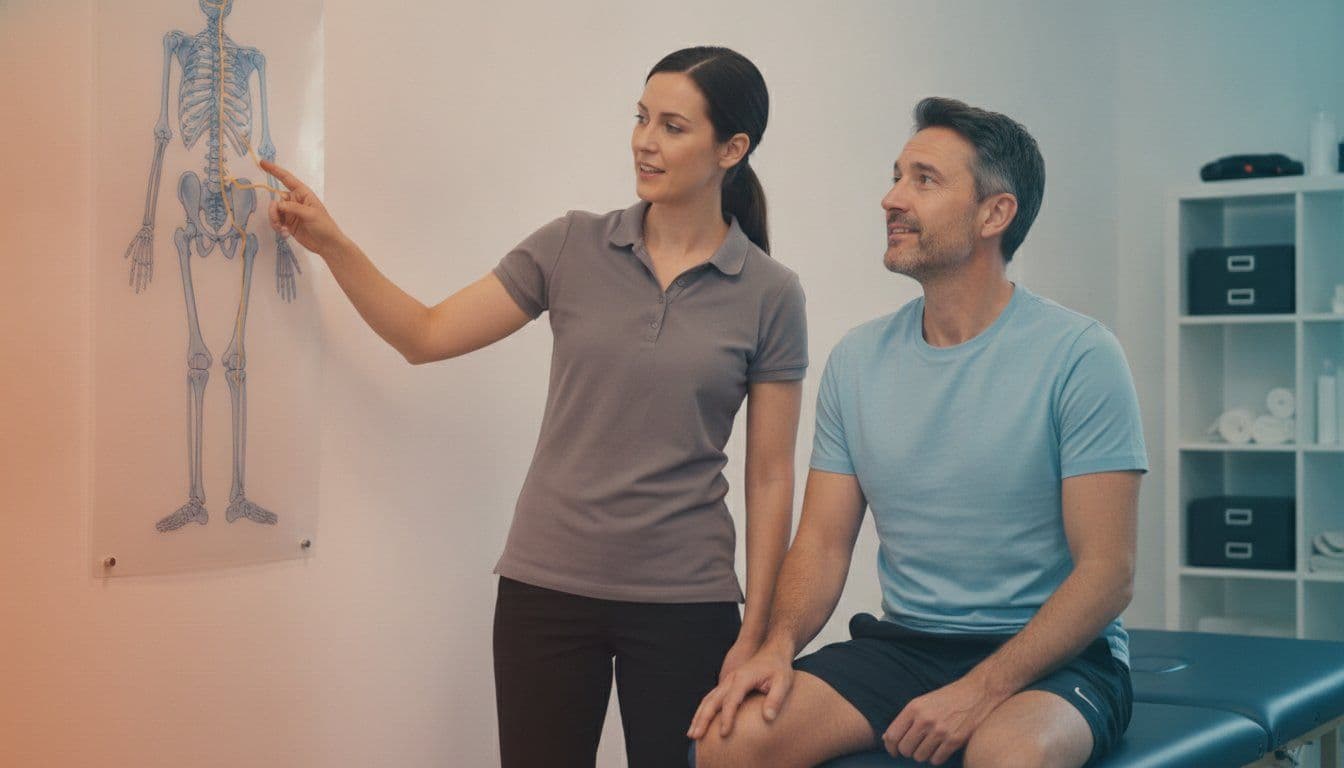
Sciatica Treatment in Milton Keynes and Northampton: Get Back to Your Life Faster
Fed up with sciatica pain? Get fast, hands-on sciatica treatment in Milton Keynes & Northampton. Skip the NHS wait and find real relief with our expert physios.
What if that lightning bolt shooting down your leg isn't a permanent sentence to the sofa, but a signal that your body just needs the right hands-on intervention? It's incredibly frustrating when you're stuck in a loop of painkillers and "rest," especially when the wait for effective sciatica treatment stretches out for months while you can't even sit through a morning meeting. You might even fear that surgery is your only way out. We understand that feeling of being stuck. At our clinics in Milton Keynes and Northampton, we see people every day who are exhausted by the sharp, shooting pain and the uncertainty of when they'll feel normal again.
In this article, you'll discover how targeted, hands-on care can desensitise that angry nerve and get you moving again without the long NHS wait. We'll show you how to move past the "exercises-only" approach to find immediate relief and a clear recovery plan. We are going to break down the root causes of your symptoms and explain the exact steps we take to help you return to running, working, and living life to its full physical potential.
Key Takeaways
- Understand that sciatica is a symptom of nerve pressure and not a life sentence of pain.
- Discover why effective sciatica treatment starts with hands-on therapy to settle the nerve rather than just a sheet of exercises.
- Learn to distinguish between true sciatica and common mimics so you can target the actual root cause of your discomfort.
- Pick up simple, actionable adjustments for your desk and daily movements to keep you comfortable while you recover.
- Find out how to access expert care in Milton Keynes and Northampton quickly, bypassing long waiting lists and getting back to your life.
Understanding Sciatica: Why Your Leg Is Screaming
Sciatica isn't actually a disease in itself. It's a loud, often painful messenger telling you that something is pressing on or irritating the longest nerve in your body. When that nerve gets grumpy, the pain doesn't just stay in your back. It follows a very specific map, traveling from your lower back, through the buttock, and right down the back of your leg. It's a relentless sensation that can make even the simplest tasks feel like a marathon.
You might feel a sharp electric shock that makes you jump, a constant burning sensation, or just a dull, heavy ache that won't go away. Technically speaking, sciatica is the irritation of the sciatic nerve resulting in referred pain below the knee. If you're looking for a comprehensive overview of sciatica, you'll see it can vary wildly from person to person. This is why a "one size fits all" approach to sciatica treatment rarely works. You can find more details on how we identify these symptoms on our conditions page.
The Anatomy of the Sciatic Nerve
Your sciatic nerve is a bit of a beast. It's about as thick as your thumb, originating in your lumbar spine before exiting through the pelvis and heading down to your toes. Because it's so large and travels such a long distance, it has plenty of opportunities to get squeezed. It passes right under, or sometimes through, the piriformis muscle in your glutes. If that muscle gets tight or inflamed, it can trap the nerve like a vice, sending those infamous zingers down your leg.
Common Triggers for Nerve Irritation
Most of our patients in Milton Keynes and Northampton come to us with one of three main triggers. Bulging or herniated discs are the most common culprits. This happens when the soft "jelly" inside a spinal disc presses against the nerve root. Then there are degenerative changes, which is just clinical speak for "wear and tear" that narrows the gaps where nerves exit the spine as we get older.
Finally, we can't ignore the "desk job" factor. Spending eight hours a day hunched over a laptop can create postural habits that put constant mechanical stress on your lower back. This repetitive pressure irritates the nerve over time, leading to that screaming leg pain that makes getting through the workday a nightmare. Understanding these triggers is the first step toward effective sciatica treatment and getting you back to your best.
Beyond Exercises: Why Hands-On Sciatica Treatment Works
If you've spent any time searching for sciatica treatment, you've likely come across the "wait and see" approach. Many sources suggest that you should simply rest for six to twelve weeks and hope the inflammation settles on its own. We think that's rubbish. While your body is incredibly resilient, leaving a compressed nerve to its own devices often leads to weeks of unnecessary agony and muscle wasting. We don't just hand you a generic sheet of stretches and send you on your way. In fact, doing the wrong exercises too early can actually make a sensitive nerve even angrier.
Our approach centers on using hands-on therapy to "quieten down" your nervous system. When you're in the middle of a flare-up, your brain goes into a protective mode, causing the muscles around your spine and glutes to lock up. This "muscle guarding" creates a vicious cycle of more pressure and more pain. By using manual techniques, we can break this cycle, giving you immediate relief and creating a vital window of opportunity where movement becomes possible again. If you're ready to stop the cycle, you can explore our physiotherapy services to see how we start your recovery from day one.
Manual Therapy and Joint Mobilisation
We prioritise manual therapy in your very first session because it addresses the mechanical side of the problem. By gently moving the spinal segments, we help to reduce local inflammation and improve joint mobility. This isn't about "cracking" bones; it's about subtle, evidence-based mobilisations that take the direct pressure off the nerve exit points. This physical intervention is backed by any modern clinical review of sciatica as a key component in reducing acute symptoms and restoring function faster than rest alone.
Dry Needling and Soft Tissue Work
Sometimes, the pressure on your nerve isn't just coming from a disc; it's coming from deep muscle tension. We use dry needling to reach those stubborn trigger points in the piriformis or lower back that manual pressure alone might miss. Relaxing the glutes and hamstrings is vital for long-term relief. We often integrate sports massage to manage this secondary muscle guarding. This combined effort ensures we aren't just masking your symptoms but are actively changing the environment around the nerve to promote genuine healing. Our clinics in Milton Keynes and Northampton focus on these efficient, results-driven methods to get you back to your life without the long wait.
Sciatica vs. Mimics: Is It Actually Your Sciatic Nerve?
One of the most common reasons people don't see results is that they're treating the wrong structure. Not every pain that travels down your leg is true sciatica caused by a disc. In fact, referred pain from nearby joints can perfectly mimic nerve symptoms, leading you down a path of ineffective stretches and frustration. It's easy to get caught in a loop of treating the symptom rather than the source. We look at the whole picture to ensure we're treating the right structure from your very first visit.
Misdiagnosis is a major reason why many people struggle to find lasting relief. When you explore sciatica treatment options, you need to be certain about what's actually going on in your body. If your leg pain is actually coming from a stiff joint or a grumpy muscle, a plan focused solely on your spinal discs won't help. Our goal is to give you a clear, accurate diagnosis so we can get you back to your life faster. We don't believe in guesswork.
The Sacroiliac (SI) Joint Connection
Your SI joint connects your spine to your pelvis. When it's out of sync or irritated, it can send pain radiating into your thigh and even down to your knee. This sacroiliac joint pain requires a very different approach than a herniated disc. We use specific physical tests to differentiate between the spine and the pelvis. This ensures we're not just guessing, but treating the actual cause of your symptoms. It's about precision, not just luck.
Piriformis Syndrome and Muscle Entrapment
Sometimes, the problem is a muscle in your buttock called the piriformis. Because the sciatic nerve runs right past it, any muscle tension here can pinch the nerve. People often try to "stretch it out," but if the nerve is already sensitive, aggressive stretching can actually make the entrapment worse. We focus on releasing the muscle safely to take the pressure off. Whether you visit us in Milton Keynes, Northampton, or Towcester, we'll make sure your sciatica treatment is tailored to the exact site of the problem. We want to get you moving without the pain returning the moment you leave the clinic.
Practical Steps to Manage Sciatica at Home and Work
While we focus on providing effective sciatica treatment in the clinic, your recovery doesn't stop when you walk out our doors. Think of your daily activity as a "pain budget." If you spend all your energy sitting at a desk in Milton Keynes or Northampton without a break, you'll likely overspend and end up in a flare-up. Movement is medicine, but it has to be the right kind. Small, frequent movements are far better than one long walk followed by hours of sitting. At work, ensure your screen is at eye level and your feet are flat on the floor; even a small rolled-up towel behind your lower back can provide much-needed support for your lumbar spine.
When the sun goes down and your leg starts throbbing, finding a comfortable sleeping position feels like a challenge. Try lying on your side with a pillow between your knees to keep your hips level, or on your back with a pillow under your knees to flatten the curve of your spine. These small adjustments can reduce the mechanical pull on the nerve, helping you get the rest you need to heal. Managing your environment is just as important as the physical therapy itself.
First Aid for Sciatic Flare-Ups
The debate between heat and ice is a common one. For the first 48 hours, ice is usually your best bet for settling acute inflammation. After that, heat can help relax the muscle guarding that often follows. Try "positions of ease," such as lying on the floor with your legs resting on a chair at a 90 degree angle, to take the mechanical tension off the nerve. Once the initial fire has settled, your sciatica treatment plan might include gentle nerve flossing, which is a specific movement that glides the nerve through its path to encourage blood flow and speed up your recovery.
When to Seek Urgent Help
Safety is our priority. You must seek immediate medical attention if you notice "red flags" such as changes in your bladder or bowel habits, numbness in your saddle area, or sudden weakness in both legs. These can be signs of a serious condition that requires urgent hospital care. For most other cases, a professional trapped nerve assessment is far safer than trying to self-diagnose. If you're tired of the guesswork and want to get back to your life faster, book a professional assessment with our team today.
The RED Approach: Personalised Sciatica Recovery in Northamptonshire
At RED Physiotherapy, we don't believe in the "wait and see" approach that leaves you stuck on a sofa for months. Our clinics in Milton Keynes, Northampton, and Towcester are built on a simple, family-run philosophy: we treat people, not just symptoms. We know how frustrating it is to be told to "just rest" when you can't even sit through a morning meeting or pick up your children without a bolt of pain. That is why we provide hands-on sciatica treatment from your very first visit, focusing on settling your nervous system so you can start moving properly again.
You won't find any generic, photocopied exercise sheets here. Instead, we provide a clear, honest plan that respects your time and targets your specific goals. Whether you want to get back to training for a marathon or simply want to walk to the shops without agony, we are here to bridge the gap between where you are and where you want to be. We pride ourselves on being a faster, more effective alternative to long NHS waiting lists, offering expert care when you actually need it.
Diagnostic Excellence and Advanced Care
To get you back to your life faster, we use advanced tools like musculoskeletal ultrasound for pain. This allows us to look under the skin and see exactly what is happening with your tissues, removing the guesswork from your diagnosis. For stubborn or chronic cases that haven't responded to traditional methods, we offer shockwave therapy to stimulate healing in deep, sensitive areas. By combining clinical expertise with modern technology, we ensure your path to recovery is as efficient as possible.
Booking Your Path to Relief
Your journey starts with a comprehensive assessment where we listen to your story and perform a thorough physical exam. We believe in transparent pricing and a straightforward booking process so you can focus entirely on your recovery. You'll leave your first session with a clear understanding of the root cause of your pain and a concrete plan to fix it. Join the hundreds of local patients who have reclaimed their mobility and their passions by choosing a practice that puts your progress first.
Sciatica doesn't have to be a permanent part of your life. By choosing a hands-on, patient-first approach, you can desensitise the nerve, rebuild your strength, and return to the activities that make life worth living. If you are ready to stop managing the pain and start fixing the problem, we are ready to help you take that first step toward lasting relief.
Focus Keywords: sciatica treatment, shockwave therapy, musculoskeletal ultrasound for pain, physiotherapy Milton Keynes, physiotherapy Northampton, trapped nerve relief.
Take the First Step Toward Pain-Free Movement
You don't have to stay stuck in a cycle of sharp, shooting pain and endless waiting lists. We've explored how understanding the mechanics of your nerve irritation and getting an accurate diagnosis can change everything. Whether your symptoms are driven by a disc issue or a mimic like the SI joint, the right path forward involves far more than just a sheet of generic stretches.
Our expert team across Milton Keynes, Northampton, and Towcester is dedicated to identifying and fixing the root cause of your discomfort. We believe in providing hands-on treatment from day one to settle your symptoms and restore your confidence. If you're ready for effective, personalised sciatica treatment that prioritises your goals, we're here to help you get back to your life faster.
Book your hands-on sciatica assessment today and start your journey toward lasting relief. You have the potential to reach your full physical potential; let's get you there together.
Frequently Asked Questions
How long does it take for sciatica to go away with physiotherapy?
Most patients notice a real difference within 4 to 6 weeks of starting a structured programme. The exact timeline depends on the root cause and how long you've been struggling. We focus on getting you moving from day one, using hands-on techniques to settle the nerve so you can progress through your recovery plan efficiently without unnecessary delays.
Can I still exercise if I have sciatica pain?
You can and should stay active, but you must choose the right movements. High-impact sports or heavy lifting might irritate the nerve further, but low-impact activities like swimming or gentle mobility work are usually helpful. We'll show you exactly how to modify your training so it supports your sciatica treatment rather than setting you back.
Is walking good for sciatica or will it make it worse?
Walking is usually very helpful as it keeps the spine mobile and improves circulation. The trick is to keep your walks short and frequent rather than going for one long trek that flares you up. If you notice the pain increasing down your leg, it's a sign to shorten your stride or take a break.
Do I need an MRI scan before I start treatment for sciatica?
You don't need to wait for an MRI to begin your recovery. Our clinical assessments are highly accurate at identifying the source of nerve pressure. While scans are helpful in complex cases, most people can start effective sciatica treatment immediately after their first assessment with us in Milton Keynes or Northampton.
Why does my sciatica feel worse when I am sitting at my desk?
Sitting increases the mechanical pressure on your lumbar discs, which can directly compress the sciatic nerve. If you're hunched over a laptop in Milton Keynes or Northampton, you're essentially asking your discs to do a lot of heavy lifting. We recommend standing up every 30 minutes and adjusting your chair to ensure your lower back is properly supported.
What is the best sleeping position for sciatic nerve pain?
Side-sleeping with a pillow tucked between your knees is usually the winner for nerve comfort. This position keeps your hips level and prevents your spine from twisting during the night. If you're a back sleeper, placing a pillow under your knees can take the physical tension off your lower back and help the nerve rest while you sleep.
Can sports massage help with my sciatica symptoms?
Yes, sports massage is a fantastic tool for managing the muscle tension that follows a nerve flare-up. When you're in pain, your glutes and hamstrings often lock up to protect the area. Massage helps to release this "guarding," which reduces the total pressure on the nerve and makes it much easier for you to move without that constant pulling sensation.
Will I need surgery for a herniated disc causing sciatica?
Surgery is actually a bit of a last resort and isn't nearly as common as people fear. Most herniated discs actually settle down on their own with the right physical intervention. Unless you're experiencing specific "red flag" symptoms or progressive weakness, a proactive, hands-on approach is usually the most effective and fastest path to a full recovery.
Tags:
About the Author
Red Physiotherapy Team
Content Team
Health and wellness content from the RED Physiotherapy team.