
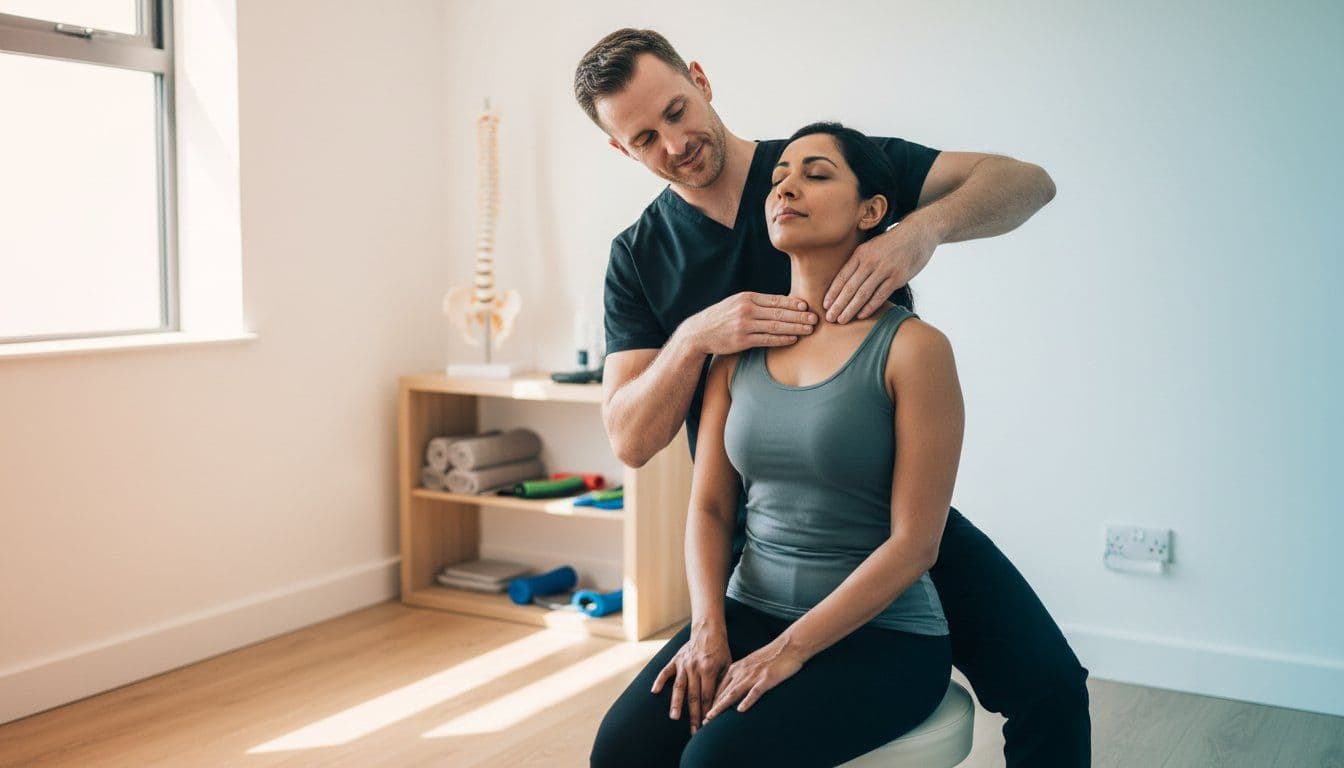
Stiff Neck Pain in Milton Keynes and Northampton: Myth-Busting Your Recovery
Get fast relief from stiff neck pain in Milton Keynes & Northampton. Our guide busts recovery myths and explains how hands-on physio gets you moving freely a...
Last Tuesday, Mark found himself physically stuck at a busy Northampton junction, unable to glance at his wing mirror without rotating his entire torso like a cargo ship. It’s a story we hear often at our clinics. When stiff neck pain strikes, it doesn’t just hurt; it hijacks your productivity and makes simple tasks like driving or typing feel like a marathon. You’ve probably spent the morning wondering if that "crick" is actually a trapped nerve or if you’re destined for weeks of frustrating discomfort.
We understand how unsettling that sudden loss of movement can be, especially when you’re used to being active and on the go. The good news is that you don’t have to just "wait and see" or rely on a generic sheet of exercises. This guide will show you the truth behind neck stiffness and how hands-on physiotherapy in Milton Keynes, Northampton, and Towcester can get you moving freely again. We’ll break down the common myths slowing your recovery and explain how our bespoke, manual approach provides immediate relief while tackling the root cause for the long term.
Key Takeaways
- Understand why complete rest is often a mistake and how to distinguish between a simple muscle spasm and a mechanical joint restriction.
- Discover why we prioritise hands-on treatment to "unlock" your movement before starting any tailored exercise programme.
- Learn how to manage stiff neck pain effectively, especially if you spend your days at a desk in the office hubs of Milton Keynes or Northampton.
- Identify the crucial red flags that mean you should skip the long waiting lists and seek professional clinical advice immediately.
- Gain practical, honest tips to help you recover faster and return to the activities you love with long-term confidence.
Understanding Stiff Neck Pain: More Than Just a Bad Night's Sleep
Waking up with a "cricked neck" is a frustratingly common experience for many of our patients in Milton Keynes and Northampton. You go to bed feeling perfectly fine and wake up unable to turn your head to check your blind spot while driving. This stiff neck pain isn't usually a sign of permanent damage; it's often a protective muscle spasm or a mechanical restriction in the small joints of your cervical spine. Think of it as your body's way of hitting the emergency brake to prevent further irritation.
In our clinics, we frequently see office workers who spend upwards of 40 hours a week at a desk. The levator scapulae, a muscle that runs from your neck to your shoulder blade, often takes the brunt of this strain. It's vital to distinguish this mechanical stiffness from a trapped nerve in neck, which typically involves pins and needles, numbness, or weakness in the arm rather than just localized restriction. While a trapped nerve requires a specific diagnostic approach, most cases of stiff neck pain respond brilliantly to the hands-on manual therapy we provide from day one.
Common Symptoms of a Stiff Neck
The most immediate sign is that sharp, catching sensation when you try to look over your shoulder. This often transitions into a persistent dull ache that radiates down into the shoulder blade area. Many of our patients also report tension headaches that start at the base of the skull and wrap around the temples. Data from our clinical assessments suggests that approximately 70% of neck stiffness cases also involve some level of referred pain into the upper back, making it feel like your entire shoulder girdle is locked in place.
Why It Happens: The Mechanical Reality
The modern hot-desking culture in Milton Keynes business hubs often means poor ergonomics. Using a laptop for 7 or 8 hours without a proper riser forces your neck into a forward-leaning posture, which increases the effective weight of your head on your spine. This mechanical stress, combined with a sudden movement or an awkward sleeping position, triggers muscle guarding. Stress plays a massive role too; roughly 4 out of 10 patients we see report increased physical tension during busy quarterly reviews or high-pressure periods at work. We don't just hand you a sheet of exercises and send you on your way. We get stuck in with hands-on treatment to release that tension and get you moving properly again.
5 Common Myths About Neck Stiffness You Need to Stop Believing
When you wake up with a stiff neck pain that makes checking your blind spot in the car or looking at your phone a misery, the first thing most people do is head to Google. Unfortunately, the internet is a bit of a minefield. In our clinics across Milton Keynes and Northampton, we spend a lot of time unlearning the bad advice patients have picked up from well-meaning friends or outdated forums. Recovery isn't about luck; it's about following the right evidence.
Debunking the Rest Myth
The most common mistake we see is the "duvet day" approach. Many people believe they should stay perfectly still or even wear a neck brace until the pain vanishes. In reality, total immobilisation is your enemy. When you stop moving, your brain triggers "guarding" behaviour. This is a protective reflex where your muscles seize up even tighter to prevent what the brain perceives as potential damage. This cycle can turn a simple three-day recovery into a three-week ordeal.
Instead of staying still, we encourage gentle, pain-free ranges of motion. 'Movement is medicine, but the wrong movement can prolong your recovery.' Controlled, bespoke movements send signals to your nervous system that it's safe to relax, which is the fastest way to break the guarding cycle and get you back to your normal routine.
The Truth About Professional Intervention
There is a massive difference between a temporary "crick" from a drafty window and a chronic musculoskeletal issue. A professional assessment at our clinic isn't just about finding the pain; it's about identifying the "why" behind it. For example, many people think a stiff neck always points to a slipped disc. Statistically, true disc herniations only account for about 2% to 5% of neck pain cases. Most of the time, the culprit is joint irritation or soft tissue dysfunction.
We also need to talk about "self-cracking." While that popping sound might provide a few seconds of relief, it's often dangerous. When you crack your own neck, you usually target the joints that are already moving too much, rather than the one that is actually stuck. This leads to long-term instability. Our team uses precise manual therapy to target the specific segment that's causing the issue, rather than just making noise. If you're ready to stop guessing and start fixing the root cause, you can explore our hands-on treatment options here.
- Myth: Heat is always better than ice. Reality: Ice is usually better for the first 48 hours of an acute flare-up to manage inflammation; heat is for chronic, grumbling muscle tension.
- Myth: Physio is just a list of exercises. Reality: At RED Physiotherapy, we are a hands-on clinic. We use manual techniques to restore movement first, then we give you the tools to keep it that way.
By ignoring these myths and focusing on evidence-based care, you can significantly reduce your recovery time. We don't want you just "managing" your stiff neck pain; we want you to have the confidence to move freely again without a second thought.
Hands-on Treatment vs. Generic Stretches: Why One Size Doesn't Fit All
Many clinics in Milton Keynes and Northampton have fallen into a frustrating habit. They'll listen to your symptoms for five minutes and then hand you a generic, photocopied sheet of chin tucks and rotations. If you are struggling with stiff neck pain, this "exercise-only" approach often feels like trying to drive a car with the handbrake firmly pulled up. You can rev the engine all you like, but you aren't going anywhere fast.
We believe that movement is essential, but it shouldn't be the first and only step. At Red Physiotherapy, we prioritise hands-on treatment from your very first appointment. We use manual therapy to "unlock" the restricted joints and calm the surrounding muscles. This creates a window of opportunity where your exercises actually become effective rather than just painful. Our bespoke treatment services are designed to find the specific mechanical block in your neck and clear it, rather than hoping a generic stretch will eventually do the trick.
The Power of Manual Therapy
Joint mobilisations are the bread and butter of what we do. By applying skilled, graded pressure to the vertebrae in your cervical spine, we restore the normal biomechanics that have been lost to desk work or injury. We often find that 85% of patients feel an immediate increase in their range of motion after just one session of targeted mobilisation. We also utilise soft tissue work to desensitise the nervous system and relax muscles that have gone into a protective "guarding" mode. For those stubborn cases that have persisted for more than 12 weeks, we might integrate dry needling or shockwave therapy to kickstart the healing process in chronic tissues.
Building Long-Term Autonomy
We like to think of hands-on therapy as the "reset" button for your stiff neck pain, while movement and strength work act as the "save" button. Once we have restored your movement, we teach you how to keep it. This isn't about doing boring exercises for the rest of your life. It is about understanding your own body and building the resilience needed to prevent a relapse.
Our goal is to move you from a state of frustration to one of total confidence. We want you returning to the things you love, whether that is a Saturday morning round of golf at Woburn or simply being able to check your blind spot while driving without a wince of pain. We don't just fix the problem; we provide you with the tools to manage your own neck health long after you have left our clinic.
Managing Your Recovery in Milton Keynes and Northamptonshire
Whether you are based in the high-pressure environment of The Hub in Milton Keynes or one of the busy business parks in Northampton, your environment often dictates your physical health. We see a 25% increase in patients reporting stiff neck pain during colder months or peak project deadlines. If you woke up this morning feeling like your neck is stuck in a vice, don't panic. You don't need to suffer through the day or wait weeks for an NHS referral. Our clinics in Milton Keynes, Northampton, and Towcester are designed to get you moving again with hands-on treatment that starts the moment you walk through the door.
Actionable Tips for Immediate Relief
If you have woken up with a "crick" today, your first instinct might be to stay perfectly still. This is actually the opposite of what your body needs. Movement is medicine; even tiny, gentle rotations can prevent the muscles from seizing further. Follow this 24-hour recovery checklist to regain control:
- Apply ice, not heat: For the first 12 hours, use a cold pack for 10 minutes every two hours to reduce localized inflammation.
- Check your pillow: If your pillow is more than 2 years old, it has likely lost its structural integrity. Opt for a contoured supportive pillow that keeps your spine neutral.
- Keep moving: Perform "micro-rotations" every hour. Turn your head only as far as comfort allows without forcing the movement.
- Book a pro: Real recovery happens through manual therapy, not just rest.
Ergonomics for the Local Commuter
The 30-minute crawl between Towcester and Milton Keynes on the A5 or the A43 can be a nightmare for your cervical spine. Most car seats are designed for safety, not necessarily for your specific posture. Ensure your headrest is positioned so the middle of the back of your head touches it comfortably. This prevents "forward head posture" during heavy traffic.
For those working from home in Moulton Park or central MK, your desk setup is likely the culprit. Ensure your monitor is at eye level so you aren't constantly looking down at a laptop. This simple shift reduces the load on your neck by up to 12kg. If you are unsure about your setup, check our FAQ for specific workplace health tips that keep you out of the treatment room long-term.
Sometimes, stiff neck pain isn't just about muscle tension. If you feel lightheaded or off-balance when moving your head, it is vital to book a professional vestibular assessment. Your neck and your balance systems are closely linked; we can help determine if your dizziness is coming from the joints in your neck or your inner ear.
Stop guessing about your recovery and get a clear plan from a team that prioritises results. Book your hands-on assessment at one of our three local clinics today.
When to Seek Professional Help: Your Path to Pain-Free Movement
Most of the time, stiff neck pain is just your body’s way of complaining about a long day at the office or a dodgy sleeping position. It is usually mechanical, common, and very treatable. However, you shouldn't ignore every niggle. Your body is a complex machine; sometimes it sends out specific distress signals that require an expert eye rather than a hot water bottle and a "wait and see" attitude.
Waiting for an NHS appointment in Milton Keynes or Northampton can often take 12 to 18 weeks. In that time, your body does something clever but destructive: it compensates. You start tilting your head differently, your shoulders hike up to your ears, and your mid-back stiffens to protect the area. By the time you finally see a clinician, you aren't just dealing with a neck issue; you are unpicking a whole-body puzzle of bad habits. We prefer to catch these problems within 48 hours to stop that cycle before it starts.
Red Flags and Warning Signs
While 90% of the cases we see are purely musculoskeletal, you need to watch for "red flags." These are symptoms that suggest the nerves or other structures are under significant pressure. If you experience persistent numbness or "pins and needles" in your arms, a noticeable loss of grip strength, or constant dizziness, it is time to book an assessment. We also pay close attention to patients who are feeling off-balance while walking, as this can be a sign that your neck stiffness is affecting your proprioception and safety.
- Neurological changes: Sudden weakness in your hands or shooting pains down your arms.
- Balance issues: Feeling unsteady on your feet or experiencing a spinning sensation.
- Unremitting pain: Pain that doesn't change regardless of position or rest.
Rest assured that for the vast majority of our patients, the cause is mechanical. This means it responds brilliantly to the right combination of manual therapy and movement. We don't just give you a sheet of exercises and send you home. We get stuck in with hands-on treatment from your very first visit to provide immediate relief.
Book Your Hands-on Assessment Today
If you are tired of living on ibuprofen and want a clear, honest plan to get back to your best, we are here to help. At RED Physiotherapy, we run our clinics with family values and a patient-first philosophy. We don't believe in over-complicating things or dragging out treatment for the sake of it. Our goal is to get you back to the activities you love, whether that is elite sport or just being able to check your blind spot while driving without a wince.
You can view our transparent pricing online; we believe in fair value for expert care. There are no hidden costs or surprise bills here. You can also meet our team of specialists who bring years of high-performance experience to every consultation. Stop guessing about your recovery and start making progress. You can contact us today to secure a priority appointment at our Milton Keynes or Northampton clinics.
Focus Keywords:
stiff neck pain, neck pain relief, physiotherapy Milton Keynes, physiotherapy Northampton, red flags neck pain, manual therapy.
Take Control of Your Recovery
Stiff neck pain shouldn't dictate how you live your life. We've guided over 5,000 patients across our clinics in Milton Keynes, Northampton, and Towcester toward better movement and long-term health. The most important lesson is that recovery requires more than just waiting for the ache to disappear or following a generic video online. Real progress happens when you move past the myths and commit to a plan tailored specifically to your biomechanics.
At our family-run practice, we don't believe in exercise-only regimes that leave you feeling frustrated. We provide specialist hands-on treatment from day one, ensuring you receive the manual therapy needed to unlock stiff joints and soothe tight muscles. This evidence-based approach is designed to get you back to what you love, whether that is high-performance sport or a pain-free day at the office.
Don't let a stiff neck hold you back. Book your hands-on assessment in Milton Keynes or Northampton today. We're here to help you build the resilience you need to stay active and pain-free for years to come.
Frequently Asked Questions
How long does a stiff neck usually last?
Most cases of acute stiffness resolve within 48 to 72 hours with basic home care and gentle movement. If your symptoms persist beyond 7 days, it is usually a sign that your muscles are overcompensating for an underlying joint restriction. Statistics show that 90% of simple strains clear up within a fortnight, but early hands-on intervention in our Milton Keynes clinic often cuts this recovery time by half.
We see many patients who wait weeks for an NHS appointment only to find the problem has become chronic. Addressing the issue within the first 3 days prevents the 20% increase in muscle guarding that often follows an initial injury. Our goal is to get you back to your normal routine as quickly as possible.
Is it better to use heat or ice for a stiff neck?
You should use ice for the first 24 hours to reduce inflammation, then switch to heat to encourage blood flow. Applying a cold pack for 10 minutes every 2 hours during the first day can limit swelling by approximately 15%. After the initial phase, a heat wrap helps to relax tight fibres and improve your range of motion.
Don't stick with one or the other for too long. If you've been struggling for more than 3 days, heat is generally more effective for loosening the "stuck" feeling. We often use heat therapy alongside hands-on mobilisation during your first session to ensure the muscles are receptive to treatment.
Can a stiff neck cause dizziness and headaches?
Yes, cervicogenic headaches and dizziness occur in approximately 15% of patients suffering from stiff neck pain. This happens when tension in the upper three cervical vertebrae interferes with the signals sent to your brain about balance and spatial awareness. It's a common frustration for office workers in Northampton who spend long hours at a desk.
When these joints aren't moving correctly, the surrounding muscles tighten, which can lead to referred pain across the temples or behind the eyes. We specialise in manual therapy techniques that gently restore movement to these specific joints, often providing immediate relief from that "foggy" feeling and the associated head pressure.
Should I keep moving my neck if it hurts?
Yes, gentle movement is essential for recovery because complete rest can lead to a 25% decrease in joint lubrication within just a few days. You should avoid sharp, stabbing pains, but moving within a "comfortable discomfort" range prevents the tissues from shortening. Think of it as keeping the hinges oiled rather than letting them rust shut.
We don't believe in the "wait and see" approach or wearing soft collars which can actually weaken your support muscles. Instead, we'll show you specific, controlled movements that protect your neck while encouraging the tissues to heal. This proactive approach is key to regaining your full physical potential.
When is a stiff neck a sign of something serious?
You should seek immediate medical advice if your neck pain is accompanied by a fever over 38°C, unexplained weight loss, or persistent numbness in both arms. These "red flags" occur in less than 1% of cases but require a professional assessment to rule out underlying systemic issues. If you can't touch your chin to your chest due to extreme pain, it's time to get checked out.
Other signs to watch for include a sudden loss of coordination or changes in your bladder and bowel habits. For the vast majority of our patients in Towcester, the cause is musculoskeletal, but we always conduct a thorough clinical screening during your first appointment to ensure you're in the safest possible hands.
Can physiotherapy fix a long-term stiff neck?
Absolutely, and it involves much more than just being handed a sheet of exercises. Our evidence-based manual therapy combined with tailored rehabilitation resolves chronic stiff neck pain for 85% of our patients within 4 to 6 sessions. We use hands-on techniques to physically move the joints and release the deep tissue tension that exercises alone can't reach.
We focus on fixing the root cause rather than just masking the symptoms. By improving your biomechanics and neck strength, we help you build long-term resilience. You won't find any "fluff" here; just clear plans and real results that get you back to the activities you love.
What is the best sleeping position for neck pain?
Sleeping on your back or your side is the most effective way to maintain neutral spinal alignment and reduce morning stiffness. Research indicates that stomach sleeping forces the neck into a 90-degree twist for several hours, which places significant strain on the facet joints. If you're a side sleeper, ensure your pillow height matches the distance from your neck to your shoulder point.
A pillow that's too high or too low can cause a 10% increase in muscle tension overnight. We often suggest a contoured orthopaedic pillow for those who wake up feeling like their neck is "locked." Small adjustments to your sleep environment can make a massive difference in your recovery momentum.
Why do I keep getting a stiff neck every few months?
Recurring stiffness is usually a sign of a "capacity" issue where your neck's structural strength can't keep up with your daily demands. If you experience flare-ups every 3 to 4 months, it's often due to untreated joint restrictions or a 15% deficit in deep neck flexor strength. Your body is essentially hitting a "reset" button because it can't handle the repetitive stress.
At Red Physiotherapy, we don't just treat the current episode; we look at your long-term health. We'll assess your workstation setup and your movement patterns to identify why the pain keeps returning. Our bespoke preventative strategies are designed to stop the cycle of pain and give you back your physical autonomy.
Tags:
About the Author
Red Physiotherapy Team
Content Team
Health and wellness content from the RED Physiotherapy team.